

Most pre-retirees spend decades building a nest egg, then move to a state that quietly takes a chunk of it back every single year. If you’re approaching retirement in Central Florida, or anywhere else in the country, the state you choose to live in could mean the difference between keeping every dollar of your Social Security, 401(k), IRA, and pension income, or watching thousands disappear annually to state taxes you didn’t have to pay.
The good news? There are 13 states in 2026 where retirement is essentially tax-free at the state level. The bad news? Most retirees never run the numbers, and many end up in the wrong state by default.
This guide breaks down all 13 tax-friendly retirement states, what “tax-free” actually means in each one, the hidden costs to watch for, and how to decide whether relocating, or staying put, makes sense for your retirement income plan.
If you’d rather have a financial professional walk you through your specific situation, you can book a free virtual Retirement Clarity Session . For daily retirement tax tips and visual breakdowns like the map at the top of this post, follow on Instagram.
Why State Taxes on Retirement Income Matter More Than You Think
Federal taxes get most of the attention in retirement planning conversations. But for retirees living on a fixed income, state taxes can quietly cost tens of thousands of dollars over a 20- or 30-year retirement.
Consider two retirees with identical situations: $40,000 in Social Security, $30,000 in pension income, and $30,000 in 401(k) withdrawals. That’s $100,000 in annual retirement income.
- In a state with no income tax (like Florida, Texas, or Tennessee), the state tax bill is $0.
- In a state with a 5% flat tax on retirement income, that same retiree could owe $3,000 to $5,000 per year in state income tax.
- Over a 25-year retirement, that’s $75,000 to $125,000 lost to state taxes alone, before you factor in inflation, growth, or compounding.
That’s not pocket change. That’s a year of living expenses, a paid-off vehicle, a grandchild’s college fund, or a meaningful inheritance for your kids.
For pre-retirees in their 50s and early 60s, this is one of the most controllable variables in your entire retirement income plan. Unlike market returns or future tax law changes, where you live in retirement is a choice you can make on purpose.
What “Tax-Free Retirement” Actually Means
Before we get to the list, let’s clarify what we mean by “tax-free retirement income.” A state qualifies as tax-friendly for retirees when it doesn’t tax the four major sources of retirement income:
- Social Security benefits
- 401(k) and 403(b) withdrawals
- Traditional IRA distributions
- Pension income (private and public)
Some states accomplish this by having no state income tax at all. Others tax wages but specifically exempt retirement income. Both approaches put more money in your pocket each month.
Important caveat: “Tax-free retirement” at the state level does not mean “tax-free everywhere.” You’ll still owe federal income tax on most retirement distributions (Roth accounts being the exception). And state income tax is just one piece of the puzzle. Property taxes, sales taxes, estate taxes, and overall cost of living all factor into the real picture, which is why this list isn’t a ranking. It’s a starting point.
The 13 States Where Retirement Is Tax-Free in 2026
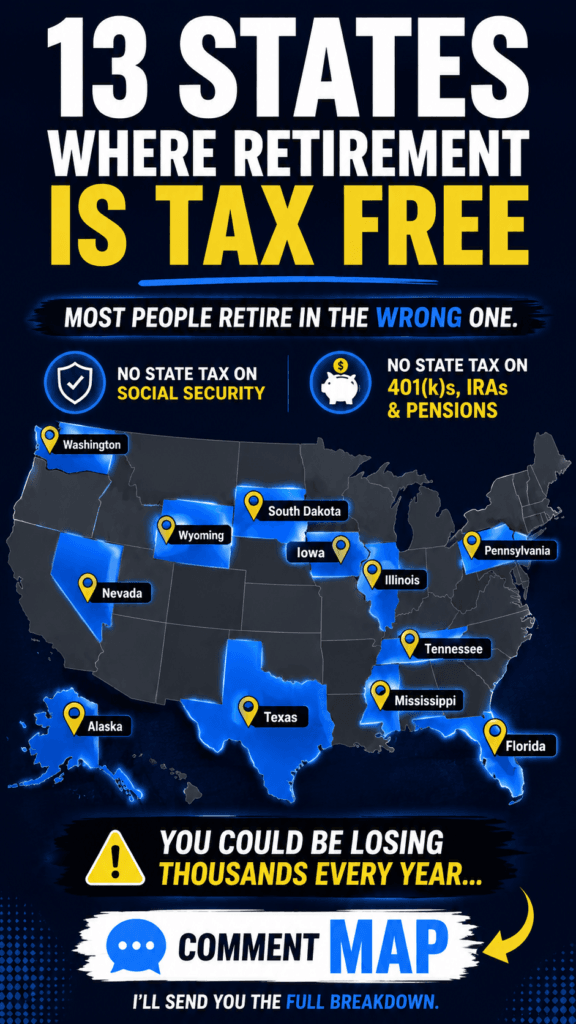
Here are the 13 states that don’t tax Social Security, 401(k)s, IRAs, or pensions in 2026, broken into two groups: states with no income tax at all, and states that tax wages but exempt retirement income.
Group 1: States With No State Income Tax
These nine states don’t tax any income, period. Wages, retirement distributions, Social Security, investment income, all of it is exempt at the state level.
1. Florida
The Sunshine State is the gold standard for retiree tax friendliness, and not just because of the weather. Florida has no state income tax, no tax on Social Security, no tax on 401(k) or IRA withdrawals, no tax on pensions, and no estate or inheritance tax.
For Central Florida retirees, that means every dollar of your retirement income stays in your pocket at the state level. Combine that with the senior homestead exemption, the additional $50,000 exemption available for qualifying low-income seniors in many counties, and the absence of an estate tax, and Florida becomes one of the most retirement-friendly states in the country.
Watch out for: Property taxes vary widely by county, and homeowners insurance has risen significantly in recent years. Always run a true total-cost-of-living analysis before assuming “no income tax” automatically means cheaper.
2. Texas
Texas, like Florida, has no state income tax. That covers Social Security, IRAs, 401(k)s, and pensions. The state also offers a generous homestead exemption for homeowners 65 and older.
Watch out for: Texas has some of the highest property tax rates in the country, often 1.6% to 2%+ of assessed home value. For retirees with paid-off, high-value homes, that can offset a meaningful chunk of the income tax savings.
3. Tennessee
Tennessee fully eliminated its tax on investment income (the old “Hall Tax”) in 2021, making it a true no-income-tax state. Social Security, pensions, IRAs, and 401(k) withdrawals are all tax-free.
Watch out for: Tennessee has one of the highest combined sales tax rates in the country, with state and local sales taxes often pushing past 9.5%. Groceries are taxed too. Retirees with high consumption (or expensive medical needs not covered by Medicare) may feel that bite.
4. Nevada
Nevada has no state income tax and no estate tax. Retirees who like the desert lifestyle, the proximity to outdoor recreation, or the entertainment options of Las Vegas and Reno often find Nevada attractive.
Watch out for: Sales tax in Nevada averages around 8.2%, and certain counties can run higher. Property tax rates are relatively low, however.
5. Wyoming
Wyoming consistently ranks among the most tax-friendly states in the country for retirees. No income tax, low property taxes, no estate tax, and a low sales tax rate make it a hidden gem.
Watch out for: Wyoming’s appeal isn’t for everyone. Cold winters, sparse population, and limited specialty healthcare access in many parts of the state can be drawbacks for retirees who want urban amenities.
6. South Dakota
South Dakota has no state income tax and no estate or inheritance tax. Property taxes are moderate. The state is actively recruiting retirees, and South Dakota also has favorable trust and asset protection laws that some high-net-worth retirees use for legacy planning.
7. Alaska
Alaska is unique. Not only is there no state income tax, residents actually receive an annual Permanent Fund Dividend check from the state’s oil revenues. Sales tax is handled at the local level and is typically low or nonexistent.
Watch out for: The cost of living in Alaska, especially for groceries, healthcare, and home heating, is among the highest in the country. The lifestyle is also not for everyone.
8. Washington
Washington has no state income tax on wages, pensions, IRA distributions, or Social Security.
Watch out for: Washington imposes a 7% capital gains tax on long-term gains above a threshold (currently $270,000+), so high-net-worth retirees with significant taxable brokerage accounts should plan accordingly. Sales tax is also relatively high.
9. New Hampshire
(While not pictured on the original graphic, New Hampshire belongs in this category as of 2026.) New Hampshire fully repealed its Interest and Dividends Tax effective January 1, 2025, making it a complete no-income-tax state. Retirees keep 100% of their retirement distributions at the state level.
Group 2: States With Income Tax That Exempt Retirement Income
These states tax wages and other types of income, but specifically carve out exemptions for retirement income.
10. Pennsylvania
Pennsylvania has a flat 3.07% income tax on wages, but all retirement income is exempt for retirees who are eligible (typically after age 59½). That includes Social Security, pension distributions, 401(k) withdrawals, and IRA distributions.
Watch out for: Pennsylvania has both an inheritance tax and relatively high property taxes in many counties.
11. Illinois
Illinois has a 4.95% flat income tax on wages, but all retirement income (Social Security, pensions, 401(k)s, IRAs) is exempt from state income tax. That makes Illinois one of the most generous retirement income tax policies in the country, on paper.
Watch out for: Illinois has some of the highest property taxes in the nation (averaging close to 2% of home value), high sales taxes in many areas, and an estate tax with a relatively low exemption threshold. The “tax-free retirement” headline is real, but the total tax picture can be heavy.
12. Mississippi
Mississippi exempts Social Security, pensions, 401(k) and IRA distributions from state income tax. Other income (wages, investments above certain thresholds) is taxed at a flat 4% in 2026, with the rate scheduled to drop further in coming years and the state aiming to eliminate income tax entirely over time.
Watch out for: Mississippi taxes groceries at 5%, which can hit retirees on fixed incomes harder than other tax types.
13. Iowa
As of January 1, 2023, Iowa exempts retirement income from state income tax for residents age 55 and older. That includes Social Security, pensions, IRAs, and 401(k) distributions. For early retirees under 55, the exemption may not yet apply, so timing matters.
Watch out for: Property taxes in Iowa are above the national average.
Two Important Updates for 2026 You Should Know About
State tax laws change. Here are two recent developments that didn’t make the original 13-state graphic but are highly relevant if you’re planning your retirement location for 2026 and beyond.
Michigan Joins the List in 2026
Michigan completed a multi-year phaseout of its retirement income tax. Starting with the 2026 tax year, most pensions, 401(k) and IRA withdrawals, and other retirement income are exempt up to $67,610 (single filers) or $135,220 (joint filers). That effectively makes Michigan a 14th tax-friendly retirement state for the majority of middle-income retirees.
West Virginia Eliminates Social Security Tax
West Virginia completed its three-year phaseout of state tax on Social Security benefits. As of January 1, 2026, all West Virginia residents are fully exempt from state tax on Social Security, regardless of income level. Other retirement income is still taxed, so it’s not a fully tax-free retirement state, but Social Security recipients see meaningful relief.
These kinds of changes happen every year, which is why retirement income planning isn’t a “set it and forget it” exercise. Tax law shifts. Phaseouts complete. New exemptions are introduced. The state that’s tax-friendly today may not be the most tax-friendly option five years from now.
Hidden Costs: Why “No Income Tax” Doesn’t Always Mean “Lower Taxes”
Here’s where most retiree relocation conversations go off the rails. People see “no state income tax” and assume they’ll automatically save money. Sometimes they will. Sometimes they won’t.
To know whether moving (or staying) actually lowers your total tax burden, you need to look at the full tax stack:
Property Taxes
Texas, Illinois, and Iowa all have notably high property tax rates. If you’re moving from a low-property-tax state to a no-income-tax state with high property taxes, you might break even, or end up worse off, especially if your home value is significant.
Florida’s property taxes are moderate by national standards, and the homestead exemption for primary residences plus the senior exemption available in many counties helps. But insurance premiums (homeowners and flood) have climbed significantly in coastal areas, and that’s effectively a tax on living there.
Sales Taxes
Tennessee, Washington, and Nevada all have sales taxes that, when combined with local rates, can exceed 9% to 10%. Retirees with high discretionary spending, or those who spend heavily on big-ticket items like vehicles, RVs, or home renovations, will feel that.
Estate and Inheritance Taxes
Most of the 13 states on this list have no estate or inheritance tax, which is great for legacy planning. Pennsylvania and Illinois are exceptions to watch. If passing wealth to your heirs is a priority, the absence of an estate tax in states like Florida, Texas, Nevada, and Wyoming is a meaningful planning advantage.
Cost of Living
State taxes are one input. The price of groceries, healthcare, housing, insurance, utilities, and transportation matter just as much. A retiree saving $4,000 a year on state income taxes but spending $8,000 more on housing and insurance has gone backwards.
This is why a real retirement tax analysis isn’t just “which state has the lowest income tax.” It’s “which combination of state, lifestyle, and income strategy keeps the most money in my pocket over a 20- to 30-year retirement?”
Should You Move to a Tax-Free Retirement State?
This is the question I get from pre-retirees in Orlando and across Central Florida (and, increasingly, virtually from clients in higher-tax states considering a move). Here’s the honest answer: it depends, and the math is more nuanced than most people realize.
Reasons to Consider Relocating
- You’re currently in a high-tax state. California, New York, New Jersey, Minnesota, and Oregon all tax retirement income at meaningful rates. Moving could save tens of thousands over a long retirement.
- You’re flexible on lifestyle. If you’re not deeply rooted to family, weather, or community in your current state, the financial case for relocating gets stronger.
- You have significant retirement income. The more you’re drawing from taxable retirement accounts, the bigger the absolute savings.
- You want to simplify estate planning. Moving from an estate-tax state to one without can save your heirs significantly.
Reasons to Stay Put
- Family ties. Grandchildren, aging parents, and adult kids are usually worth more than a tax savings.
- Your current state already exempts retirement income. If you live in Pennsylvania, Illinois, or Iowa (after 55), you may already be getting most of the retirement tax benefit without moving.
- The total tax picture in your state is fine. Some “high tax” states have offsetting benefits, like senior property tax freezes, generous medical expense deductions, or strong public services.
- The cost and stress of a move outweighs the savings. Especially in your 70s and 80s, relocation gets harder, more expensive, and more disruptive.
A Smart Middle Path: Establish Residency Strategically
Some retirees who split time between two states use strategic residency planning to legally establish their primary residence in a tax-friendly state while still spending meaningful time elsewhere. This is more complex than just buying a Florida condo and calling yourself a resident, states like New York are aggressive about challenging residency claims, but done correctly, it’s a legitimate strategy used by many retirees with the means to maintain two homes.
How Florida Stacks Up for Central Florida Retirees
Since I’m based in Orlando and serve a lot of clients across Central Florida, this question comes up constantly: is Florida really the best retirement state, or is that just hype?
The honest answer: Florida is genuinely one of the most tax-friendly states in the country for retirees, but “best” depends on your full financial picture.
Where Florida Wins
- No state income tax on any retirement income
- No tax on Social Security
- No estate or inheritance tax
- Strong homestead protection
- Senior property tax exemptions in many counties
- Favorable creditor protection laws (homestead is largely shielded)
- Year-round access to outdoor recreation and lower heating costs
Where Florida Has Tradeoffs
- Homeowners insurance and flood insurance costs have risen significantly in many areas
- Property taxes vary by county and can be meaningful in higher-value markets
- Hurricane risk and the related preparation costs
- Healthcare access varies by region
- Summer heat and humidity aren’t for everyone
For a pre-retiree in Central Florida who already lives here, the calculation is usually straightforward: you’re already in one of the best retirement tax states in the country. The bigger question becomes how to optimize your retirement income strategy within Florida, not whether to leave.
Florida vs. High-Tax States: A Real Numbers Comparison
For pre-retirees considering whether to relocate to Florida (or stay in Florida), seeing the numbers side by side often clarifies the decision faster than any general advice. Here’s a simplified comparison using a hypothetical $100,000 annual retirement income, broken into $40,000 Social Security, $30,000 pension, and $30,000 traditional IRA withdrawals.
Florida (No Income Tax)
State income tax owed: $0
That’s it. Every dollar of your retirement income is yours to spend, save, or pass on, at least at the state level.
California (High-Tax State)
California taxes pension and IRA distributions at progressive rates, with retirement income often falling in the 6% to 9.3% bracket. Social Security is exempt. On $60,000 of taxable retirement income (pension plus IRA), a California retiree could owe roughly $2,500 to $4,500 per year in state income tax, depending on deductions and filing status.
Over a 25-year retirement, that’s potentially $80,000 to $120,000 in lifetime state taxes that a Florida retiree simply doesn’t pay.
New York (High-Tax State With Pension Exemptions)
New York exempts Social Security entirely and allows a $20,000 pension and IRA exclusion per person ($30,000 under proposed legislation). Beyond that, retirement income is taxed at progressive rates that typically land between 5% and 6.85% for middle-income retirees. A retiree drawing more than the exemption would owe roughly $1,500 to $3,000 annually.
New Jersey (High-Tax State With Generous Senior Exclusions)
New Jersey has expanded its retirement income exclusion significantly. For retirees 62 and older with income under specific thresholds, New Jersey allows substantial exclusions on pension and retirement account income. But high earners and those exceeding the income threshold can lose the exclusion entirely, creating a “cliff” that’s worth understanding before assuming you’re protected.
What This Means
For a Central Florida retiree with $100,000 in retirement income, staying in Florida instead of moving to a high-tax state could be worth $50,000 to $150,000 over a typical retirement. That’s not a marketing number, that’s compounding state tax savings on real income over real years.
For someone currently in California, New York, or New Jersey considering a move to Florida, the reverse calculation applies, but with the added complexity of cost of living, housing prices, family proximity, and lifestyle factors. The numbers favor Florida; the decision is bigger than the numbers.
How to Legally Establish Residency in a Tax-Friendly State
If you decide that relocating makes sense, the IRS, your old state, and your new state all have a stake in where you actually live. States like New York, California, and New Jersey are particularly aggressive about challenging residency claims when high earners or retirees with significant income try to leave. Doing it correctly matters.
Steps That Establish Residency
To establish bona fide residency in a tax-friendly state, you generally want to take as many of the following steps as possible:
- Spend the majority of the year in your new state. The traditional “183-day rule” is a starting point, but several states require more than just day-counting.
- Get a driver’s license and register your vehicles in the new state.
- Register to vote and actually vote in the new state.
- Update your mailing address on all financial accounts, IRS records, Social Security, Medicare, and Medicaid (if applicable).
- Update your estate planning documents (will, trust, power of attorney, healthcare directive) to reflect new state law.
- File a homestead exemption on your new primary residence (Florida’s homestead protection is one of the strongest in the country).
- Move your “center of life” indicators: doctors, dentists, banks, primary social and religious affiliations.
- File a final part-year resident return in your old state and a resident return in your new state.
Common Mistakes That Trigger Audits
- Keeping your old home as the “primary” residence while claiming to live elsewhere
- Maintaining business interests, professional licenses, or memberships that suggest your old state is still home
- Spending more than 183 days in the old state, even unintentionally
- Telling the old state on your final return that you’re a “non-resident” without strong supporting documentation
For retirees making this transition, working with both a tax professional and a financial professional who understand multi-state retirement planning is worth the investment. The cost of getting it wrong can dwarf the cost of doing it right.
What Most Retirees Get Wrong About State Tax Planning
After working with pre-retirees and retirees in Central Florida and across the country, I see the same mistakes over and over again. Here are the big ones.
Mistake 1: Focusing Only on Income Tax
Income tax is one of four or five tax categories that affect retirees. Property tax, sales tax, estate tax, and overall cost of living can completely flip the calculation. The headline rate is rarely the full story.
Mistake 2: Not Coordinating State Taxes With Withdrawal Strategy
The order in which you draw from retirement accounts (taxable, tax-deferred, Roth) interacts with state tax law. A withdrawal that looks tax-efficient at the federal level can be tax-inefficient at the state level, and vice versa. Real retirement income planning coordinates both.
Mistake 3: Ignoring Roth Conversions
If you live in a no-income-tax state, Roth conversions become significantly more attractive because you only pay federal tax on the conversion, with no state tax piling on top. Pre-retirees who plan to spend their retirement in Florida, Texas, or another no-income-tax state often have a 5- to 10-year window where strategic Roth conversions can dramatically reduce lifetime taxes. Most retirees never run this analysis.
Mistake 4: Assuming Tax Law Won’t Change
State and federal tax law changes constantly. Michigan and West Virginia just changed in 2026. Mississippi is phasing out its income tax over the coming years. A static plan built on today’s rates will be wrong in five years. Retirement income planning is an ongoing process, not a one-time event.
Mistake 5: Going It Alone
Most retirees I meet have done a great job saving and investing. Where they struggle is the transition from accumulation to income, the phase where tax planning, withdrawal sequencing, Social Security claiming, and Medicare interact in ways that can cost six figures over a long retirement if handled poorly.
Your Next Step: Get Clarity on Your Specific Situation
Reading a blog post about tax-friendly states is a useful start. But your retirement is not a generic situation. Your income mix, your account types, your goals, your family situation, and your timeline are unique. A real retirement income plan accounts for all of it.
That’s exactly what I do with pre-retirees and retirees in a free virtual Retirement Clarity Session. We’ll walk through:
- How your current state taxes your retirement income (and whether moving could actually save you money)
- Whether Roth conversions make sense given your tax bracket and state of residence
- How to coordinate Social Security claiming with your withdrawal strategy
- What your retirement income looks like after taxes (the number that actually matters)
- Strategies to protect your income from inflation, market downturns, and longevity risk
Sessions are virtual, free, and there’s no obligation. Whether you’re in Orlando, the rest of Central Florida, or anywhere else in the country, we can meet over Zoom.
Book your free Retirement Clarity Session here: go.rogerfishel.com
For daily retirement income tips, tax updates, and visual breakdowns like the map at the top of this post, follow @orlandoretirementcoach on Instagram.
Frequently Asked Questions About Tax-Free Retirement States
Which state is the absolute best for retirement taxes?
There’s no single “best” state for everyone. Florida, Wyoming, and Nevada consistently rank near the top because they combine no income tax with no estate tax and reasonable overall costs. But the right state for you depends on your full financial picture, family situation, and lifestyle preferences.
Do I have to move to avoid state taxes on my Social Security?
Not necessarily. Approximately 42 states plus D.C. don’t tax Social Security in 2026. Even if your state has an income tax, your Social Security benefits may already be exempt. The question is how the rest of your retirement income (pensions, IRA, 401(k) distributions) is taxed.
What about Roth IRAs and Roth 401(k)s?
Qualified Roth distributions are tax-free at both the federal and state level in every state. That’s one of the biggest advantages of Roth accounts in retirement, they’re truly tax-free regardless of where you live.
Will tax laws stay the same?
No. State tax laws change every year. Michigan, West Virginia, Mississippi, and several other states have all made meaningful changes in the last few years. A retirement income plan needs to be reviewed and adjusted as laws and your situation evolve.
Is Florida really tax-free for retirees?
For state income tax purposes, yes. Florida does not tax Social Security, IRA, 401(k), or pension income, and there’s no estate or inheritance tax. You’ll still owe federal income tax on most retirement distributions, and you’ll still pay property tax, sales tax, and insurance, but at the state income tax level, Florida retirement income is genuinely tax-free.
Should I do Roth conversions before I retire?
Often yes, especially if you plan to live in a no-income-tax state. The window between retirement and required minimum distributions (currently age 73 or 75 depending on birth year) is often the lowest tax bracket period of a retiree’s life, making it an ideal time for strategic conversions. But it requires careful planning. This is something we walk through in a Retirement Clarity Session.
Roger Fishel is a financial professional and retirement income planner based in Orlando, Florida. Roger Fishel Financial serves pre-retirees and retirees in Central Florida and nationwide via virtual meetings, with a focus on tax-efficient retirement income strategies, Social Security planning, and protected income solutions. To schedule a free virtual Retirement Clarity Session, visit go.rogerfishel.com.
This article is for educational purposes only and does not constitute tax, legal, or investment advice. State tax laws change frequently and individual circumstances vary. Consult a qualified financial professional before making decisions about your retirement income plan.