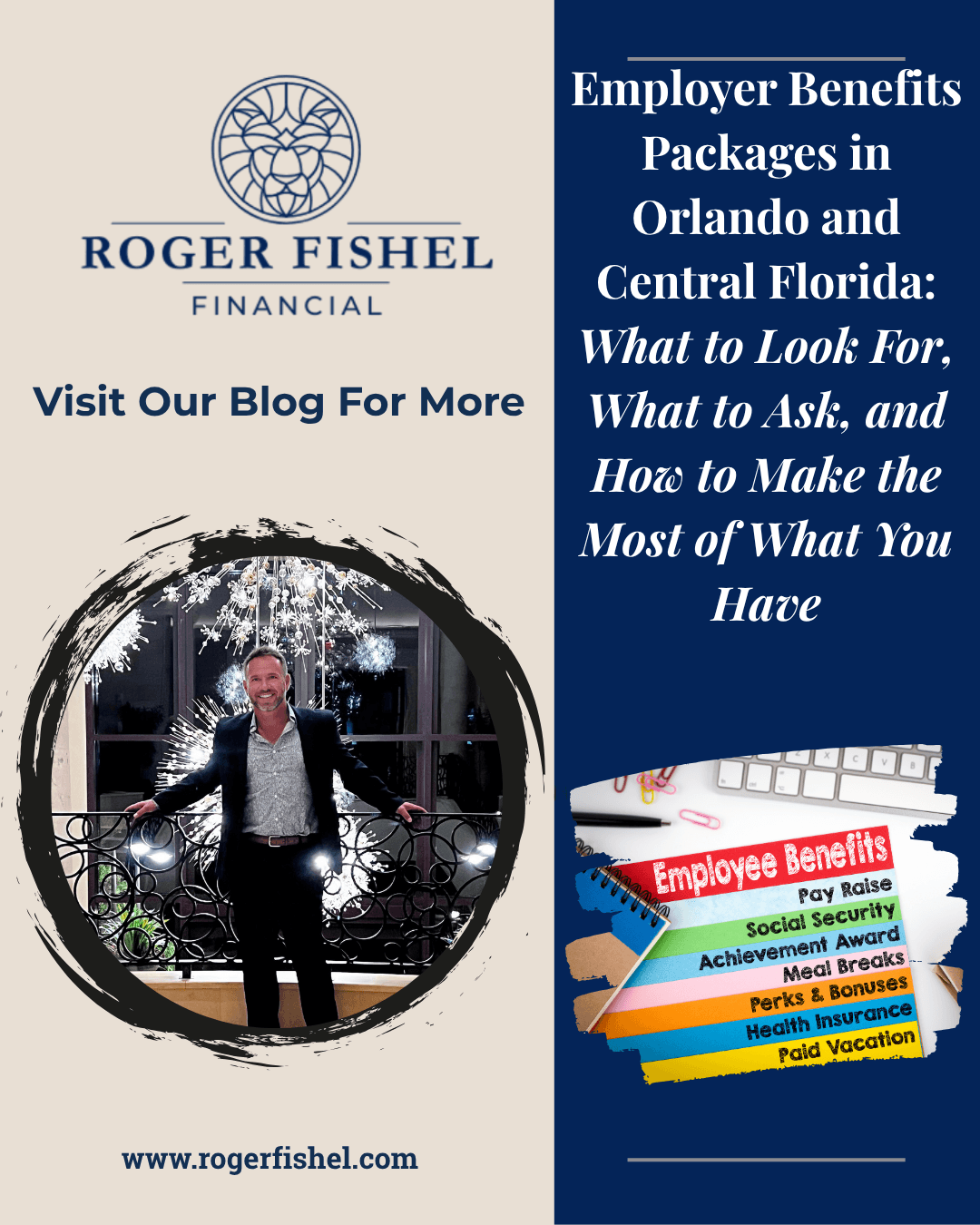
If you work for a company in Orlando, Tampa, Kissimmee, Lake Nona, Sanford, Lakeland, Deltona, or anywhere across Central Florida, your employer benefits package is one of the most valuable pieces of your total compensation. Most workers underestimate it. Many ignore it entirely until open enrollment rolls around, then rush through their selections without understanding what they are choosing or what they are leaving on the table.
The cost of that inattention can be significant. A poorly chosen health insurance plan can cost a family thousands of extra dollars per year. An employer 401(k) match that goes uncollected is free money left behind. A group life insurance policy that is not properly evaluated can leave a family underprotected or paying for coverage they do not need. A flexible spending account (FSA) or health savings account (HSA) that is misunderstood or ignored can mean paying taxes on dollars you could have sheltered.
This guide is written specifically for workers and pre-retirees in the Orlando and Central Florida area. Whether you work for one of the region’s major employers, including AdventHealth, Orlando Health, Lockheed Martin, Walt Disney World, Universal, Darden Restaurants, Marriott, Publix, the University of Central Florida, or a smaller local business, understanding your benefits package is one of the highest-return financial moves you can make.
We will walk through every major component of a typical employer benefits package, what to look for, what questions to ask, common mistakes to avoid, and how each piece connects to your broader retirement income plan.
Why Your Benefits Package Matters More Than You Think
Compensation is not just your salary. For most full-time employees in Central Florida, the total value of an employer benefits package can add 20% to 40% on top of your base pay when you factor in employer contributions to health insurance premiums, retirement plan matches, paid time off, disability insurance, and other perks.
Florida has no state income tax, which is a significant financial advantage compared to workers in states like Georgia, North Carolina, or California. That makes tax-advantaged benefits, including retirement accounts and health savings accounts, even more valuable here, because you are already keeping more of your paycheck and can compound those savings faster.
For pre-retirees, typically those between ages 50 and 65, your employer benefits package is not just about right now. It is directly tied to your retirement income strategy. Your 401(k) contributions during your final working years, your access to retiree health coverage, your pension if you have one, and how you manage your HSA can all have a lasting effect on your retirement security.
Let’s break down each major benefit category so you know what you are working with.
Health Insurance: The Core of Your Benefits Package
Health insurance is usually the centerpiece of any employer benefits package and for most Central Florida workers it is also the most expensive and most consequential choice. Florida’s healthcare landscape is broad, with major systems like AdventHealth, Orlando Health, and HCA Florida serving the region, and plan networks can vary significantly by employer.
Key Terms to Understand
- Premium: The amount deducted from your paycheck, usually pre-tax, to pay for coverage. Your employer typically covers a portion and you pay the rest.
- Deductible: The amount you pay out-of-pocket before insurance starts covering most services. A $2,000 deductible means you pay the first $2,000 of covered medical costs each year.
- Out-of-Pocket Maximum: The most you will pay in a given year. After hitting this cap, insurance covers 100% of covered services. This number is critical for families with significant medical needs.
- Copay: A fixed amount you pay for a specific service, such as $30 for a primary care visit.
- Coinsurance: Your share of costs after the deductible, expressed as a percentage. An 80/20 plan means insurance pays 80% and you pay 20% until you hit your out-of-pocket max.
- Network: The doctors and hospitals your insurance has contracts with. Using out-of-network providers typically costs far more.
- HSA Eligible Plan (HDHP): A High Deductible Health Plan that qualifies you to open and contribute to a Health Savings Account. More on this shortly.
What to Look For in a Health Insurance Plan
Do not just pick the plan with the lowest premium. That is the most common mistake workers make. Instead, calculate your total potential cost, which is the annual premium plus your deductible plus your expected out-of-pocket spending, and compare that across your plan options.
If you and your family are generally healthy with few expected medical visits, a high-deductible plan paired with an HSA is often the smarter financial move. The premium savings plus the tax benefits of the HSA can more than offset the higher deductible.
If you have ongoing prescriptions, a chronic condition, or family members who require regular specialist visits, a lower deductible plan with more predictable costs may serve you better even if the monthly premium is higher.
Also check whether your current doctors and preferred hospitals are in-network. In Central Florida, major systems like AdventHealth and Orlando Health contract with different insurers, and going out of network can result in very large unexpected bills.
For Pre-Retirees: Health Coverage Planning
If you plan to retire before age 65, when Medicare begins, bridging health coverage is one of the most important and often most expensive challenges you will face. Some Orlando-area employers offer retiree health benefits; most do not. If yours does, understand exactly what that coverage looks like and what it costs before you build your retirement income plan around it.
If your employer does not offer retiree health coverage, your options include COBRA (typically very expensive), a marketplace plan through HealthCare.gov, a spouse’s employer plan if applicable, or a short-term health plan. Planning for this gap in your retirement income analysis is essential.
The Health Savings Account (HSA): One of the Most Powerful Tools in Your Benefits Package
If your employer offers a High Deductible Health Plan (HDHP) paired with a Health Savings Account, and you are not maxing out that HSA, you are likely leaving one of the best tax deals available on the table.
The HSA is the only account in the tax code that offers a triple tax advantage. Contributions go in pre-tax (or are tax-deductible if you contribute directly). The money grows tax-free. And withdrawals are tax-free when used for qualified medical expenses. No other account offers all three.
2026 HSA Contribution Limits
- Self-only HDHP coverage: $4,400 in 2026
- Family HDHP coverage: $8,750 in 2026
- Catch-up contribution for those age 55 and older: an additional $1,000 per year
The HSA as a Retirement Account
Here is something many Central Florida workers do not realize: after age 65, you can withdraw HSA funds for any reason, not just medical expenses, without penalty. You will owe ordinary income tax on non-medical withdrawals at that point, just like a traditional IRA. But for medical expenses, which tend to be significant in retirement, withdrawals remain completely tax-free.
Fidelity estimates that a couple retiring at 65 today may need over $300,000 in today’s dollars to cover healthcare costs in retirement. An HSA that has been growing and compounding for decades can be a powerful source of tax-free income to cover those costs.
Strategy: If you can afford to pay current medical expenses out of pocket and let your HSA grow invested, you are building what some financial planners call a stealth IRA, one with better tax treatment than either a traditional or Roth IRA for healthcare spending.
Flexible Spending Accounts (FSAs): Use Them or Lose Them
A Flexible Spending Account is another pre-tax benefit many employers in Central Florida offer. You contribute a set amount at the start of the year, and those dollars can be used tax-free for eligible medical expenses or dependent care costs.
Unlike an HSA, FSA funds generally do not roll over year to year. You must use the balance by the plan year deadline or forfeit the unused amount (some plans allow a carryover, up to $680 for 2026, or a grace period; check yours carefully). This use-it-or-lose-it feature causes many workers to either contribute too little and miss the tax savings, or contribute too much and forfeit funds at year end.
The 2026 contribution limit for healthcare FSAs is $3,400. For dependent care FSAs, the limit increased substantially to $7,500 per household for 2026 (the first increase since 1986, when it had been $5,000), or $3,750 for married couples filing separately. If you have predictable childcare or eldercare expenses, a dependent care FSA is one of the most straightforward tax-savings tools available to you, and the higher 2026 limit makes it more valuable than ever.
Retirement Plans: Your 401(k), 403(b), and Pension Options
For most workers in Central Florida, the employer-sponsored retirement plan is the single largest wealth-building vehicle available to them. Whether it is a 401(k) at a private company, a 403(b) at a hospital or university, or a pension through a government employer, understanding how it works and how to optimize it is foundational to your retirement income plan.
The Employer Match: Never Leave Free Money Behind
If your employer offers a 401(k) or 403(b) match, contributing at least enough to capture the full match is the single highest-priority financial action you can take. A common match structure is 100% of the first 3% of salary, plus 50% of the next 2%, for a total potential employer contribution of 4% of your salary. If you earn $80,000 and your employer offers this match but you only contribute 2%, you are leaving $1,600 per year of free compensation uncollected.
2026 Contribution Limits
- Employee contribution limit (2026): $24,500
- Catch-up contribution for those age 50 and older (2026): $8,000 additional, for a total of $32,500
- Super catch-up for ages 60 to 63 (SECURE 2.0): $11,250 additional, for a total of $35,750
- Combined employee and employer limit (2026): $72,000
- New for 2026: if your prior-year FICA wages exceeded $150,000, your age 50+ catch-up contributions must be made as Roth (after-tax) dollars
Traditional vs. Roth 401(k): Which Should You Choose?
Many Orlando-area employers now offer both traditional (pre-tax) and Roth (after-tax) 401(k) options. This is an important choice with long-term tax implications.
Traditional 401(k) contributions reduce your taxable income today. You defer taxes until retirement. This makes sense if you expect to be in a lower tax bracket in retirement than you are now, or if you want the immediate tax break to free up cash flow.
Roth 401(k) contributions are made with after-tax dollars, but the growth and qualified withdrawals are completely tax-free. This can be extremely powerful if you are in a lower bracket now than you expect to be at retirement, or if you want tax diversification in retirement to manage Required Minimum Distributions (RMDs) and Medicare surcharges.
For pre-retirees in Central Florida, the choice between traditional and Roth contributions is not one-size-fits-all. It depends on your current income, projected retirement income, Social Security strategy, and whether you anticipate large RMDs from pre-tax accounts. A thorough retirement income analysis can help clarify the right mix.
Vesting Schedules: When Do You Own the Employer Match?
Your own contributions to a 401(k) are always yours. But employer matching contributions may be subject to a vesting schedule, meaning you do not own them fully until you have been with the company for a certain number of years.
Common vesting schedules include cliff vesting (you own 0% until year three, then 100% immediately) and graded vesting (you vest gradually over four to six years). If you are considering leaving a job in Central Florida, check your vesting status first. Leaving before you are fully vested means walking away from employer contributions.
Pension Plans: A Vanishing Benefit Worth Understanding
Defined benefit pension plans, which provide a guaranteed monthly income in retirement, are rare in the private sector today. But they remain common for certain Central Florida workers, including state employees through the Florida Retirement System (FRS), school district employees, some hospital systems, and utility workers.
If you have a pension, you need to understand its benefit formula (typically based on years of service and final average salary), your vesting schedule, your options at retirement (single life vs. joint and survivor annuity), whether it is a final average pay plan or a career average plan, and how it coordinates with Social Security.
The Florida Retirement System (FRS) in particular gives state and local government employees a choice between the traditional pension plan and the FRS Investment Plan (a 401(k)-style account). The decision between these two options is significant and permanent once made, and it warrants careful analysis based on your years of service, health, expected longevity, and retirement age.
Life Insurance: Group Coverage and What It May Be Missing
Most employers in Central Florida offer some form of group life insurance as part of the benefits package, often at no cost to the employee. A common baseline is one to two times your annual salary in coverage. While this is a nice benefit, it is almost always insufficient for most working families.
A general rule of thumb is to have life insurance equal to ten to twelve times your annual income, especially if you have a mortgage (a common reality in the fast-growing suburbs of Orlando, like Winter Garden, Oviedo, Lake Mary, and St. Cloud), dependent children, a spouse who relies on your income, or outstanding debts.
Supplemental Group Life Insurance
Many employers let you purchase supplemental life insurance, typically at group rates that are more affordable than individual policies on the open market, especially if you are older or have health conditions. During your initial enrollment period or a qualifying life event (marriage, birth of a child, etc.), you may be able to buy additional coverage without a medical exam, which is called guaranteed issue.
Important: Your group life insurance does not travel with you when you leave your employer. If you rely solely on group coverage and later develop a health condition that makes individual coverage expensive or unavailable, you could find yourself underprotected at a critical time. Portable individual term or permanent life insurance should be part of your personal coverage strategy.
Disability Insurance: Protecting Your Income
Disability insurance is the most overlooked benefit in most packages, yet it may be the most important protection you have during your working years. The Social Security Administration estimates that one in four workers will experience a disabling condition before they reach retirement age. Your income is your most valuable asset, and disability insurance is what protects it.
Short-Term Disability (STD)
Short-term disability typically replaces 60% to 70% of your salary for a period of weeks to several months, often starting after a short elimination period (waiting period) of one to two weeks. Some employers offer this at no cost; others make it a voluntary benefit you pay for.
Long-Term Disability (LTD)
Long-term disability kicks in after short-term coverage ends and can provide income replacement for years or until you reach retirement age. Most group LTD policies replace 60% of pre-disability income. However, group LTD policies often have important limitations, including definitions of disability that become harder to meet over time (moving from inability to do your own job to inability to do any job) and benefit offsets that reduce payments if you receive Social Security disability income.
For higher earners and business owners in Central Florida, group LTD may not fully replace your income. An individual disability income policy (which is portable and uses your own occupation definition of disability) can fill the gap.
Dental and Vision Benefits: Small Benefits, Real Savings
Dental and vision benefits may seem minor compared to health insurance and retirement plans, but they represent real value and should not be ignored.
Dental coverage typically includes preventive care (cleanings, X-rays) at little or no cost, basic restorative care (fillings) at partial coverage, and major procedures (crowns, root canals) at reduced rates up to an annual maximum benefit. Most plans have a $1,000 to $2,000 annual benefit cap, so understanding what is covered and what falls under the cap helps you plan your dental care timing strategically.
Vision coverage usually covers an annual eye exam and a benefit toward glasses or contact lenses. If you wear glasses or contacts, this benefit pays for itself quickly. Confirm that your preferred eye care provider (there are many across the Orlando metro, from Altamonte Springs to Hunters Creek) is in-network.
Employee Assistance Programs (EAP): A Hidden Benefit
Most large employers in Central Florida offer an Employee Assistance Program, and most employees never use it or do not know it exists. An EAP typically provides free and confidential access to short-term counseling and mental health support, financial counseling and debt management assistance, legal consultations, assistance with finding childcare or eldercare services, and crisis support.
Given that these services can cost hundreds of dollars per hour on the open market, an EAP is a benefits package element worth knowing about and actually using. The services are free to you, paid for entirely by the employer, and completely confidential.
Paid Time Off, Parental Leave, and Other Fringe Benefits
Beyond insurance and retirement accounts, employer benefits packages often include a range of additional features that have real monetary value. Understanding these and using them fully is part of optimizing your total compensation.
Paid Time Off (PTO)
Florida has no state law requiring employers to provide paid vacation or paid sick leave. This makes your employer’s PTO policy a genuine differentiator in your compensation package. When comparing job offers in the Orlando area, the dollar value of PTO is real. Ten additional days of PTO for someone earning $80,000 per year is worth approximately $3,077 in paid time.
Check whether your employer’s PTO rolls over year to year, whether unused PTO is paid out upon termination, and whether there are restrictions on when or how much you can use at once.
Parental Leave
Parental leave policies vary enormously among Central Florida employers. Some large employers, including many in the technology, healthcare, and hospitality sectors, offer paid parental leave of six to sixteen weeks or more. Others provide only the unpaid job-protected leave guaranteed by the federal Family and Medical Leave Act (FMLA), which requires 12 weeks for qualifying employees at companies with 50 or more employees.
If parental leave is relevant to your life planning, confirm the specific policy, not just what HR says informally. Get it in writing through the official benefits documentation.
Tuition Assistance and Professional Development
Many Central Florida employers, especially hospitals, universities, and large corporations, offer tuition assistance or professional development benefits. The IRS allows employers to provide up to $5,250 per year in tax-free educational assistance. If your employer offers this and you have educational goals, it is a tax-advantaged way to invest in your career.
Commuter Benefits
Some Central Florida employers offer pre-tax commuter benefits, which allow you to set aside up to $340 per month (2026 limit) pre-tax for transit passes or qualified parking. Given the car-centric nature of the Orlando metro and the cost of parking in downtown areas or near tourist corridors, this benefit can reduce your commuting costs meaningfully.
Wellness Programs and Gym Subsidies
Many employers in Florida offer wellness incentives, including gym membership subsidies, wellness app access, health coaching, or cash bonuses for completing health screenings or meeting wellness goals. These are often underutilized. Check what your employer offers and take advantage of available credits.
Employee Stock Purchase Plans (ESPP) and Stock Options
If you work for a publicly traded company, you may have access to an Employee Stock Purchase Plan (ESPP), which allows you to purchase company stock at a discount, typically 10% to 15% below market price. This is an immediate guaranteed return if you sell the shares promptly. However, it is important not to let ESPP purchases result in excessive concentration in a single stock.
Stock options or Restricted Stock Units (RSUs) at growth-stage companies or large established employers represent compensation that requires careful tax planning. RSUs vest over time and are taxed as ordinary income when they vest. Understanding your vesting schedule and the tax implications is important for financial planning.
Long-Term Care Insurance: A Growing Conversation in Florida
Florida is one of the top states for retirees in the country, which means it is also a place with deep awareness of long-term care costs. Some larger employers offer voluntary long-term care insurance as part of the benefits package.
Long-term care insurance covers costs associated with extended care needs, whether in a nursing home, assisted living facility, memory care unit, or at home, that are not covered by regular health insurance or Medicare. The national median cost of a private room in a nursing home exceeds $100,000 per year, and costs in Florida’s metropolitan areas can exceed that.
If your employer offers long-term care insurance, premiums during working years are generally lower than individual policies purchased later, and you may be able to obtain coverage without medical underwriting during an initial enrollment window. This is a benefit worth evaluating carefully, especially for workers in their 40s and 50s.
Open Enrollment: The Most Important Financial Event of Your Year
Open enrollment is the annual window, usually in the fall, when you can make changes to your benefits elections for the upcoming plan year. For most benefits, this is your only opportunity to change coverage outside of a qualifying life event (marriage, divorce, birth of a child, loss of other coverage).
Treat open enrollment as a critical financial planning event, not an administrative box to check. The choices you make during this window can affect your household finances for the entire year and, in the case of retirement accounts and HSAs, for decades to come.
Open Enrollment Checklist for Central Florida Workers
- Review all health plan options side by side, including total cost scenarios, not just premiums
- Confirm your preferred doctors and specialists are in-network for the plan you choose
- Determine whether an HDHP plus HSA strategy makes sense given your expected medical costs
- Set your HSA or FSA contribution amount, and make sure it is as high as makes sense given your expected expenses
- Review your 401(k) or 403(b) contribution rate and consider increasing it, especially if you got a raise
- Confirm you are contributing at least enough to get the full employer match
- Evaluate life insurance needs and consider supplemental coverage if your group coverage falls short
- Review disability insurance options and consider voluntary LTD if your employer does not provide sufficient coverage
- Check beneficiary designations on all retirement accounts and life insurance policies
- Look for any new voluntary benefits being offered that you may not have noticed before
Common Employer Benefits Mistakes Made by Central Florida Workers
Even educated, financially aware workers make predictable mistakes with their benefits packages. Here are the most common ones to avoid.
- Not contributing enough to capture the full 401(k) match: This is the equivalent of turning down a guaranteed 50% to 100% return on investment. There is no justification for leaving employer match money uncollected.
- Defaulting to the same benefits year after year without reviewing: Your life changes. Your medical needs change. Plan offerings change. Not reviewing each year means you may be paying for benefits that no longer fit your life.
- Choosing the lowest premium health plan without comparing total costs: A low premium with a high deductible can cost more in total than a slightly higher premium with a lower deductible, depending on your actual healthcare usage.
- Ignoring the HSA entirely: Many workers enrolled in an HDHP do not maximize or even open their HSA. This is a missed triple-tax-advantage opportunity.
- Failing to update beneficiary designations: Life events such as marriage, divorce, or the death of a named beneficiary require updating your beneficiary information on retirement accounts and life insurance. This is often forgotten and can lead to unintended consequences.
- Assuming group life insurance is sufficient: One to two times your salary almost certainly does not fully protect your family. Supplemental coverage should be evaluated.
- Forfeiting FSA balances: Workers who contribute to a healthcare FSA and forget about the use-it-or-lose-it rule sometimes forfeit hundreds of dollars at year end.
- Not using the Employee Assistance Program: Free counseling, legal consultations, and financial guidance go unused because workers do not know they have access to them.
- Underestimating the value of disability insurance: Most workers insure their cars and homes without hesitation but never think about insuring their income, which is their greatest asset.
How Employer Benefits Connect to Your Retirement Income Plan
If you are in your 50s or approaching retirement in Central Florida, your employer benefits package is not just an employee perk. It is an integral part of your retirement income plan. Every decision you make during your remaining working years, from how much you contribute to your 401(k) to whether you do Roth or pre-tax contributions, to how you manage your HSA, will ripple forward into your retirement.
Here is how the key pieces connect.
The 401(k) and RMDs
Every dollar you put into a traditional 401(k) is a dollar that will eventually be subject to Required Minimum Distributions (RMDs) starting at age 73 under current law (75 under SECURE 2.0 for those born in 1960 or later). Large pre-tax balances can create what is known as a tax time bomb, forcing you to take large taxable distributions in retirement, which can push you into higher tax brackets, increase your Medicare premiums through IRMAA surcharges, and affect the taxation of your Social Security benefits.
Strategic Roth conversions during your working years and in early retirement, before RMDs kick in, can help manage this. The decision about how much to put into pre-tax vs. Roth accounts requires looking years or even decades forward.
Social Security and Your Working Years
Your Social Security benefit is based on your 35 highest-earning years. If you are in your peak earning years now, working a few additional years or delaying your Social Security claim can substantially increase your monthly benefit for life. Understanding how your employer income interacts with your Social Security calculation is a key element of pre-retirement planning.
Coordinating Benefits Across Spouses
If both you and your spouse work and have employer benefits packages, there may be opportunities to optimize coverage by coordinating plans, especially for health insurance. One spouse may have better network access or lower total costs. One may have a superior 401(k) match. Reviewing both packages together, rather than in isolation, is a smarter approach.
Questions to Ask Your HR Department
Most HR departments are glad to answer questions about benefits but rarely proactively share the depth of information employees need to make optimal decisions. Here are the key questions to ask.
- What is the full employer match formula for the 401(k) or 403(b), and what contribution do I need to make to capture the full match?
- What is the vesting schedule for employer contributions?
- Does the plan offer a Roth 401(k) option?
- Is there a mega backdoor Roth option through after-tax contributions plus in-service distributions?
- What HSA-eligible health plans do you offer, and what is the employer HSA contribution if any?
- What are the group life insurance options, and are there guaranteed-issue windows for supplemental coverage?
- What are the long-term disability plan options, and what is the definition of disability used?
- Does the company offer long-term care insurance?
- What are the details of the Employee Assistance Program?
- What is the FSA carryover or grace period policy?
- Does the company offer tuition reimbursement, and what are the conditions?
- Is there any retiree health insurance benefit for those who retire before Medicare eligibility?
Benefits Considerations Specific to Central Florida and Florida Employees
Florida’s unique economic and regulatory environment creates some benefits-specific considerations that workers in other states may not face.
- No state income tax: Florida workers do not pay state income tax, which increases the relative value of tax-deferred benefits like 401(k)s and HSAs. It also means Roth conversions face no state tax drag, making Florida an excellent state for Roth conversion planning.
- Florida Retirement System (FRS): Government employees including school teachers, state workers, county employees, and others covered by FRS have access to a pension or investment plan with significant benefits. The FRS also offers a DROP (Deferred Retirement Option Program) for eligible members, which allows you to collect pension benefits into a DROP account while continuing to work.
- High cost of employer health coverage: Florida tends to have higher health insurance costs than many states. The value of comparing plans carefully and leveraging HSAs is even greater here.
- Hurricane and disaster preparedness leave: Some Florida employers have specific policies around paid or unpaid leave during hurricane evacuations. Understand your employer’s policy before a storm season.
- No state disability insurance: Unlike some states (California, New York, New Jersey, for example), Florida has no state-mandated short-term disability insurance program. This makes your employer’s voluntary or paid STD benefit more important, not less.
Putting It All Together: A Benefits Optimization Framework
Optimizing your employer benefits package is not a single event. It is an ongoing process that should be revisited at every open enrollment, after every major life event, and as you approach retirement. Here is a simple framework to use.
Step 1: Inventory Everything
List every benefit your employer offers, even the ones you are not currently using. Include health, dental, vision, retirement accounts, life insurance, disability insurance, FSA, HSA, EAP, tuition assistance, wellness, commuter benefits, and any others.
Step 2: Assign Dollar Values
For each benefit, estimate the annual dollar value: employer contributions to health insurance, 401(k) match, life insurance coverage value, disability income protection value, and so on. This gives you a realistic picture of your total compensation.
Step 3: Identify Gaps
Compare what you have with what you need. Is your life insurance sufficient? Are you capturing the full 401(k) match? Is your disability coverage adequate? Are you leveraging the HSA? Gaps become priorities.
Step 4: Connect to Your Retirement Plan
Look at how today’s benefits decisions affect tomorrow’s retirement income. Are your 401(k) contributions optimized for tax efficiency? Is your HSA positioned as a healthcare retirement fund? Is your Social Security strategy aligned with your planned retirement date? These decisions do not exist in isolation.
Step 5: Get Professional Guidance
Benefits decisions, particularly for pre-retirees and those navigating complex situations, benefit from professional analysis. A financial advisor who specializes in retirement income planning can help you see how all the pieces fit together and avoid costly mistakes.
Get a Free Review of Your Employer Benefits Package
Your employer benefits package may be worth tens of thousands of dollars in total compensation annually. For pre-retirees in Central Florida, optimizing those benefits can mean the difference between a retirement income plan that works and one that falls short.
At Roger Fishel Financial, I work with pre-retirees and retirees throughout the Orlando area and across Central Florida, including communities like Winter Park, Windermere, Lake Mary, Oviedo, Celebration, St. Cloud, Clermont, and beyond. I also serve clients nationwide through virtual meetings.
My specialty is retirement income planning, which means I look at your employer benefits not in isolation but as part of your complete financial picture, including your Social Security strategy, retirement accounts, tax planning, healthcare coverage, and legacy goals.
I am offering a complimentary benefits package review for Orlando-area workers and pre-retirees. In this no-cost, no-obligation session, we will look at your current benefits elections, identify opportunities you may be missing, and discuss how your benefits connect to your retirement income goals.
Here is what you will get from your free benefits review:
- A side-by-side analysis of your health plan options and their true total cost
- A review of your 401(k) or 403(b) contribution rate, investment selections, and Roth vs. pre-tax strategy
- An HSA optimization assessment if your plan is eligible
- A life and disability insurance gap analysis
- An overview of how your employer benefits connect to your retirement income plan
- Specific, actionable recommendations you can implement during your next open enrollment
Visit rogerfishel.com to schedule your free benefits package review today. There is no cost and no obligation. Just a focused conversation to make sure you are getting every dollar of value from the benefits your employer is offering.
Meetings are available in person in the Orlando area, or virtually for clients anywhere in Florida or across the country.
Securities and investment advisory services offered through licensed professionals ONLY. This content is for educational purposes only and does not constitute personalized financial, tax, or legal advice. Consult a qualified advisor before making benefits or financial decisions.