
For years, $1 million has been treated as a major retirement milestone.
It is a number people recognize instantly. It sounds substantial. It often feels like the point where retirement should become possible. For some households, it represents security. For others, it feels like the bare minimum. Either way, the question that matters most is not simply whether someone has saved $1 million.
The real question is this:
How much income will $1 million generate in retirement?
That is where retirement math becomes more practical and more personal. A portfolio balance, by itself, does not pay the bills. What matters is how much income that balance can support over time, how long it may last, and what real-world factors can change the outcome.
A $1 million balance may look large on paper, but retirement income is shaped by more than the account total. It depends on how much is withdrawn each year, whether withdrawals increase over time, how inflation affects purchasing power, how market performance changes the portfolio, how long retirement lasts, what taxes apply, and whether there are other income sources such as Social Security or a pension.
This article breaks down the numbers in a simple, educational way. It explains common withdrawal-rate examples, shows how monthly income may differ at different withdrawal levels, and explores the key issues that determine what $1 million might realistically support in retirement.
The goal here is not to tell anyone what they should do. The goal is to explain how the math works so the income potential of a $1 million nest egg becomes easier to understand.
Direct Answer: How Much Income Can $1 Million Generate?
In basic terms, $1 million may generate around $30,000 to $50,000 per year under commonly discussed withdrawal-rate examples.
Here is what that looks like:
- 3% withdrawal rate = $30,000 per year
- 4% withdrawal rate = $40,000 per year
- 5% withdrawal rate = $50,000 per year
- 6% withdrawal rate = $60,000 per year
In monthly terms, that equals:
- 3% = $2,500 per month
- 4% = $3,333 per month
- 5% = $4,167 per month
- 6% = $5,000 per month
Those numbers are simple and helpful, but they are only a starting point. They do not automatically tell someone whether the income is sustainable, how long it will last, or what it will feel like in real life after inflation and taxes.
That is why the rest of the conversation matters.
Why the Income Question Matters More Than the Balance
Many retirement discussions focus on the total saved. That is understandable because balances are easy to measure. People can look at statements and see a number. Income, however, is what retirement actually runs on.
During working years, most households rely on wages or business income. In retirement, that paycheck stops or slows. The challenge becomes turning accumulated assets into a stream of income that can support day-to-day living for potentially decades.
That creates a completely different way of thinking about money.
A portfolio balance answers one question:
How much has been saved?
Retirement income answers another:
How much can be used each year without running into trouble too soon?
Those are not the same thing.
Someone may have a large account balance but still face uncertainty if they do not know how withdrawals work. Another household may have a smaller balance but also have lower expenses, strong Social Security benefits, no debt, and therefore a more manageable retirement income picture.
This is why the income side of retirement is so important. Retirement is not only about reaching a number. It is about understanding what that number can do.
What “Generate Income” Really Means
When people ask how much income $1 million will generate, they are often imagining something similar to a paycheck. But the phrase can mean several different things.
In retirement, income may come from:
- withdrawals from savings
- dividends or interest
- pension payments
- Social Security
- annuity payments
- rental income
- part-time work
- required withdrawals from certain accounts
Some of these are predictable. Some are not. Some continue for life. Some depend on account balances and market conditions.
When this article discusses how much income $1 million can generate, it is usually referring to annual withdrawals or distributions that a retirement portfolio may support. That does not necessarily mean guaranteed income. It simply refers to the amount a person might draw from the portfolio each year.
That distinction matters.
A withdrawal from a portfolio is not always the same thing as a permanent income stream. In many cases, it is a combination of investment growth and spending down principal over time. The amount available may rise or fall depending on markets, inflation, taxes, and the withdrawal pattern used.
The Most Common Starting Point: Withdrawal Rates
A common way to estimate retirement income is to use a withdrawal rate.
A withdrawal rate is the percentage of a portfolio that is withdrawn each year.
For example, if someone has a $1 million portfolio:
- withdrawing 3% means taking $30,000
- withdrawing 4% means taking $40,000
- withdrawing 5% means taking $50,000
- withdrawing 6% means taking $60,000
This approach is popular because it makes the math easy to understand. It also creates a useful framework for comparing different income levels.
But a withdrawal rate is not just a math shortcut. It is a way of thinking about sustainability.
The lower the withdrawal rate, the less pressure placed on the portfolio. The higher the withdrawal rate, the more income a retiree receives today, but the greater the risk that the balance may shrink too quickly in difficult conditions.
That does not mean one rate is universally right or wrong. It means the tradeoff becomes more important as withdrawal levels rise.
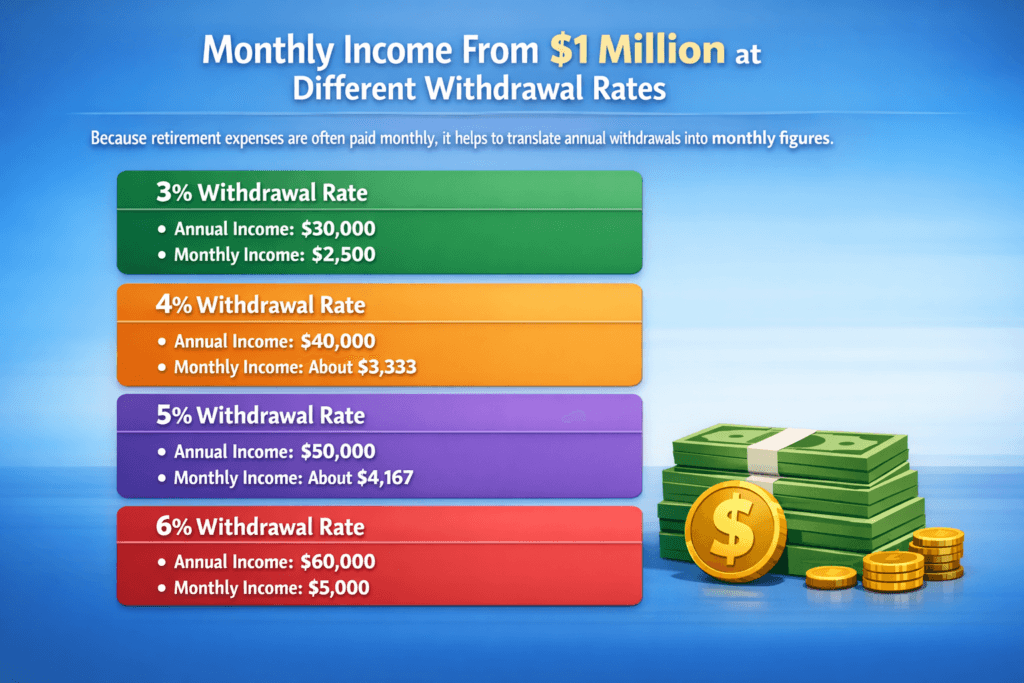
Monthly Income From $1 Million at Different Withdrawal Rates
Because retirement expenses are often paid monthly, it helps to translate annual withdrawals into monthly figures.
3% Withdrawal Rate
- Annual income: $30,000
- Monthly income: $2,500
4% Withdrawal Rate
- Annual income: $40,000
- Monthly income: about $3,333
5% Withdrawal Rate
- Annual income: $50,000
- Monthly income: about $4,167
6% Withdrawal Rate
- Annual income: $60,000
- Monthly income: $5,000
These numbers make the retirement-income question feel more real. A person can begin comparing them to current or expected expenses.
For example:
- Would $2,500 per month from savings be enough if Social Security also covers part of the budget?
- Would $3,333 per month create enough room for housing, food, healthcare, travel, and taxes?
- Would $5,000 per month be manageable over a 25- or 30-year retirement?
The monthly view helps explain why the same $1 million balance can feel very different depending on the household.
The 4% Rule and Why It Gets So Much Attention
One of the most talked-about concepts in retirement income is the 4% rule.
This idea came from research that looked at historical market data and asked a simple question: what percentage of a retirement portfolio could someone withdraw in the first year of retirement, then increase that dollar amount for inflation each year, while giving the portfolio a strong chance of lasting around 30 years?
The answer often cited was about 4%.
For a $1 million portfolio, that would mean:
- first-year withdrawal of $40,000
- then inflation adjustments each year after that
The 4% rule became popular because it provided a practical benchmark. It helped people move from vague savings goals to a more concrete income estimate.
Still, it is important to understand what the 4% rule is and what it is not.
It is:
- a historical guideline
- a planning framework
- a way to think about portfolio withdrawals
It is not:
- a guarantee
- a universal answer
- a promise that every portfolio will last
- a rule that automatically fits every retiree
Markets change. Interest rates change. Inflation changes. Retirement length changes. Spending habits change. Taxes change. Healthcare costs change. All of those factors affect how meaningful that 4% number is in real life.
Why 3%, 4%, 5%, and 6% Withdrawal Rates Feel So Different Over Time
A one-percentage-point change in withdrawal rate can seem small, but over a long retirement it can make a major difference.
Consider $1 million:
- 3% gives $30,000
- 4% gives $40,000
- 5% gives $50,000
- 6% gives $60,000
At first glance, going from 4% to 5% only adds $10,000 per year. That may not seem dramatic. But over 20 years, that is an extra $200,000 withdrawn before considering inflation. Over 30 years, the difference can become even larger.
Higher withdrawals may be workable in some periods and more stressful in others. If markets are strong early in retirement, the portfolio may absorb withdrawals more easily. If markets struggle early, higher withdrawal rates may accelerate depletion.
That is why retirement income is not only about how much comes out each year. It is also about what is happening to the portfolio while those withdrawals occur.
Inflation: The Silent Force That Changes Everything In Retirement
Inflation is one of the biggest reasons retirement-income numbers can be misleading if taken at face value.
A retiree may look at $40,000 per year from a $1 million portfolio and think that sounds workable. But the purchasing power of that $40,000 can shrink over time.
If inflation averages 3% per year, prices rise steadily. That means:
- groceries may cost more
- utilities may cost more
- insurance may cost more
- healthcare may cost more
- travel may cost more
- housing-related expenses may cost more
So even if the retiree keeps withdrawing the same dollar amount, the money buys less and less each year.
This is especially important because retirement can be long. Someone retiring in their early or mid-60s may need income for 25 to 30 years, or longer.
A useful way to think about inflation is to remember that retirement has two layers:
- Nominal income
The number of dollars withdrawn - Real purchasing power
What those dollars can actually buy
A $40,000 withdrawal may look identical on paper in year 1 and year 20, but its spending power may be very different.
A Simple Inflation Example
Imagine a retiree begins withdrawing $40,000 per year from a $1 million portfolio.
If inflation averages 3% annually, then after 10 years, that same spending lifestyle may require significantly more than $40,000 to maintain. After 20 years, it may require much more.
This creates a challenge:
- keep withdrawals flat, and purchasing power falls
- increase withdrawals with inflation, and pressure on the portfolio rises
This is one reason retirement-income discussions cannot stop at a simple annual number.
Sequence of Returns Risk: Why Timing Matters In Retirement
One of the most important retirement-income concepts is sequence of returns risk.
This refers to the danger of experiencing poor market returns early in retirement while also taking withdrawals.
Why early losses matter more:
If a portfolio drops in value during the first years of retirement and withdrawals continue, the retiree is taking money from a reduced balance. That can make it harder for the portfolio to recover later, even if the market improves.
Two retirees may earn the same average return over 30 years, but have very different outcomes depending on when the bad years occur.
For example:
- Retiree A experiences weak returns in the first 5 years
- Retiree B experiences weak returns in the last 5 years
If both withdraw income along the way, Retiree A may face a much greater risk of depleting the portfolio because early losses combine with ongoing withdrawals.
That is why retirement-income sustainability depends not only on long-term average returns, but also on the order in which those returns happen.
Why Retirement Is Different From Saving For Retirement
During the accumulation phase, market declines can be frustrating, but many savers continue contributing and have time for recovery. In retirement, the equation changes.
Retirees are often:
- no longer adding new earnings to the portfolio at the same rate
- drawing money out instead of putting money in
- relying on the account for current income
- more sensitive to short-term volatility
This makes withdrawals during down markets far more meaningful.
That does not mean every market decline causes a crisis. It means the timing and size of withdrawals matter more once retirement begins.
How Long Will $1 Million Last in Retirement?
This is one of the most common retirement questions, and the honest answer is:
It depends.
The longevity of a $1 million portfolio depends on several major factors:
- annual withdrawal amount
- market performance
- inflation
- taxes
- account type
- healthcare expenses
- longevity
- whether spending stays fixed or changes over time
- whether there are other income sources
A $1 million portfolio may last much longer when withdrawals are modest and other income sources cover a large share of expenses. It may last much less time when withdrawals are high, taxes are significant, inflation is elevated, and healthcare costs rise.
The key point is that the same starting balance can produce very different outcomes depending on the environment around it.
The Role of Social Security
For many retirees, the question is not whether $1 million alone can cover every expense. The more realistic question is how a $1 million portfolio works alongside Social Security.
Social Security may provide a meaningful portion of retirement income. If someone receives monthly Social Security income, then the portfolio may not need to support the full household budget.
For example:
- if a household needs $70,000 per year
- and Social Security provides $35,000
- then the portfolio may only need to support the remaining $35,000
In that situation, a $1 million balance may feel very different than it would for a retiree who has little or no outside income.
This is why retirement-income discussions should not isolate the portfolio from the rest of the income picture.
Pensions and Other Lifetime Income Sources
Some retirees also have pension income, though this is less common than it once was. For those who do, pension payments can reduce pressure on portfolio withdrawals.
Other income sources might include:
- rental income
- royalties
- business income
- part-time work
- structured income contracts
- spousal income if one person is still working
Every additional source of income changes how much must come from the $1 million portfolio.
The income question becomes less about whether the portfolio can do everything, and more about what role it plays.
Spending Matters More Than Many People Expect
Retirement income is not only about the money available. It is also about the money needed.
A household with low fixed expenses may find that $1 million supports a more comfortable retirement than expected. A household with high housing costs, debt, or elevated lifestyle spending may find that $1 million does not stretch nearly as far.
Major retirement spending categories often include:
- housing
- utilities
- food
- transportation
- healthcare
- insurance
- travel
- taxes
- gifts or family support
- hobbies and entertainment
- home repairs
- long-term care or caregiving costs
This is why broad retirement-income articles can only go so far. The same portfolio balance can create very different lifestyles depending on spending needs.
The Retirement Spending Smile
Retirement spending is often described as uneven across the different phases of retirement.
A common pattern is sometimes called the retirement spending smile:
Early retirement
Spending may be higher due to travel, hobbies, social activity, and catching up on experiences postponed during working years.
Middle retirement
Spending may level off or decline as routines settle and activity slows.
Later retirement
Spending may rise again, especially due to healthcare, assistance, or long-term care needs.
This pattern matters because many income discussions assume retirees spend the same amount every year. In real life, spending often shifts over time.
A retiree may not need the exact same level of portfolio withdrawals in every phase of retirement. That can make withdrawal planning more dynamic than a single flat number suggests.
Taxes Can Reduce Usable Retirement Income
A $40,000 withdrawal does not always mean $40,000 of spendable income.
Depending on the account type and the retiree’s total income picture, taxes may reduce the amount available to spend. Retirement income can come from sources that are taxed differently:
- some account withdrawals may be taxed as ordinary income
- some may have different tax treatment
- some sources may be partially taxable
- some sources may affect other income-related costs, such as Medicare premiums
Because of this, the same gross withdrawal can produce different after-tax income depending on the overall situation.
This article stays educational and does not offer tax advice, but it is important to understand that gross income and net spendable income are not always the same thing.
Why Medicare and Healthcare Costs Matter
Healthcare is one of the most important wild cards in retirement spending.
A retiree may enter retirement healthy and active, but healthcare costs often rise over time. Common expenses can include:
- premiums
- deductibles
- copays
- prescription costs
- dental, vision, and hearing expenses
- out-of-pocket medical costs
- home care
- assisted living or long-term care costs
These costs can affect how much income a portfolio needs to produce. They can also become more significant later in retirement, exactly when a retiree may be least interested in reducing withdrawals.
Healthcare is one reason a retirement portfolio cannot be judged only by early retirement lifestyle goals.
Geographic Location Changes the Math
Where a person lives can make a huge difference in what $1 million can support.
A retiree living in a lower-cost area may find that housing, taxes, and daily expenses are manageable with more modest withdrawals. Another retiree living in a high-cost area may find that the same income feels tight.
Housing alone can dramatically affect the outcome:
- owning a home free and clear creates a different budget than renting
- living in a lower-tax state may create a different net-income picture than living in a higher-tax environment
- proximity to family, healthcare, and amenities may affect both cost and lifestyle
This is why the same income number can feel generous in one place and restrictive in another.
Can You Retire on $1 Million?
This is another common question, and the most accurate educational answer is:
Yes for some people, no for others, and comfortably for some households depending on expenses and other income.
A million dollars may be enough to retire when:
- fixed expenses are reasonable
- housing costs are low or paid off
- Social Security covers a meaningful share of the budget
- healthcare costs remain manageable
- withdrawals are moderate
- retirement lasts a typical number of years rather than an unusually long one
A million dollars may be harder to retire on when:
- spending is high
- debt remains
- no other income sources exist
- healthcare costs are elevated
- inflation is high
- markets perform poorly early in retirement
- retirement begins very early and lasts several decades
So the better question is not simply “Can you retire on $1 million?” but rather:
What kind of retirement can $1 million support in the context of your expected expenses, timeline, and other income sources?
What About Couples?
Many retirement-income articles focus on one individual, but the math often changes significantly for couples.
A couple may have:
- two Social Security benefits
- shared housing costs
- different healthcare needs
- a survivor-income issue if one spouse dies first
- different longevity patterns
A couple’s $1 million portfolio may support a different lifestyle than a single retiree’s $1 million portfolio. Some expenses are shared, but not all. Certain costs decline when one spouse dies, but others remain and tax filing status may change as well.
This is why retirement-income discussions for couples are often more complex than simply doubling or halving a single-person estimate.
The Widow’s Tax Penalty and Survivor Income Issues
When one spouse dies, household income does not always fall proportionally with household expenses. In some cases, the surviving spouse may face a more difficult financial reality than expected.
Why?
Because one Social Security benefit may disappear, tax filing status may change, and some expenses may stay largely the same. That can alter how much income the portfolio needs to produce.
This issue is especially important in retirement-income discussions because a portfolio that seems manageable for a couple may feel different for a surviving spouse later.
What Happens if You Withdraw Too Much Too Early?
One of the clearest risks in retirement is withdrawing too much in the early years.
Higher withdrawals may feel manageable at first, especially if the portfolio starts strong or the retiree wants to enjoy the early years of retirement. But larger withdrawals create less margin for error if inflation rises, healthcare costs increase, or markets perform poorly.
This does not mean retirees should never spend meaningfully in early retirement. It means there is a tradeoff between present lifestyle and long-term durability.
That tradeoff is at the heart of retirement-income planning.
What Happens if You Withdraw Too Little?
The opposite issue also exists.
Some retirees become so focused on preserving money that they underspend, even when the portfolio is strong and other income sources are stable. In that case, a large nest egg may not actually improve quality of life the way it could have.
An educational retirement-income discussion should acknowledge both sides:
- withdrawing too much may increase risk
- withdrawing too little may create unnecessary restriction
That is another reason understanding the income potential of $1 million matters. It helps people move from vague fear or vague confidence into more practical thinking.
Longevity Risk: The Risk of Living a Long Time
One of the biggest retirement risks is not dying early. It is living a long time.
A long retirement is often a good thing, but it also means the portfolio must keep producing income for more years. Someone who retires at 62 and lives into their 90s may need the portfolio to support more than 30 years of withdrawals.
Longevity risk matters because it interacts with everything else:
- inflation compounds for longer
- healthcare costs may rise later
- market downturns may occur multiple times
- withdrawal pressure lasts longer
This is why a $1 million balance may seem more than sufficient for a 15-year retirement horizon but more uncertain over 30 years.
How Market Returns Affect the Income Picture
Retirement-income articles often use static withdrawal examples, but in reality portfolios rise and fall.
If returns are strong and inflation is modest, a portfolio may handle withdrawals more easily. If returns are weak and inflation is elevated, even moderate withdrawals may become more stressful.
That does not mean retirees need perfect markets. It means the income potential of $1 million is partly shaped by the environment around it.
A portfolio does not exist in a vacuum. It operates inside the real world of:
- fluctuating returns
- changing interest rates
- inflation cycles
- tax changes
- shifting spending needs
This is why any article claiming a single fixed answer is oversimplifying the issue.
The Difference Between Income Yield and Withdrawal Rate
People sometimes assume that “income generated” means natural income like interest or dividends. Others assume it means total withdrawals, even if that includes spending principal. Those are not always the same thing.
Income yield
This refers to earnings such as dividends or interest generated by assets.
Withdrawal rate
This refers to the percentage of the total portfolio withdrawn each year, whether the money comes from current income, asset sales, or both.
This difference matters because many retirees are not living only on organic yield. They may be taking a total withdrawal that includes spending part of the principal over time.
That does not automatically make it bad. It simply means the term “income generated” can be misunderstood if not explained clearly.
Real-Life Example: $1 Million With Social Security
Imagine a retiree needs $70,000 per year to cover living expenses.
If Social Security covers $30,000, the remaining need is $40,000.
In that case, a 4% withdrawal from a $1 million portfolio would produce roughly that amount.
The same $1 million feels more workable because the portfolio is not expected to do all the work.
Now imagine another retiree needs the same $70,000 per year but has very little outside income. That retiree may need to withdraw much more from the portfolio. The sustainability picture becomes very different.
This is why retirement-income estimates should always be connected to the broader household income picture.
Real-Life Example: $1 Million Without Debt
Debt can dramatically affect retirement income needs.
A household without a mortgage, car payments, or major consumer debt often has a very different retirement-income requirement than a household carrying significant obligations.
For example, someone with:
- paid-off housing
- low recurring expenses
- manageable insurance costs
- modest travel expectations
- Social Security income
may find that $1 million supports a comfortable retirement lifestyle.
The same balance may feel far less adequate for a household with:
- a mortgage
- high property-related costs
- personal debt
- elevated travel spending
- significant ongoing family support needs
Real-Life Example: Early Retirement vs Traditional Retirement Age
The age retirement begins matters.
A retiree who leaves work at 62 may need income for many more years than someone who retires at 70. That longer time horizon increases the importance of inflation, healthcare, and market uncertainty.
Early retirement may also mean:
- fewer Social Security benefits in the early years
- more years before Medicare eligibility
- more years of drawing from the portfolio
Traditional retirement age may reduce some of that pressure by shortening the drawdown period and increasing other income sources.
Again, the same $1 million can behave very differently depending on timeline.
Why the “Magic Number” Idea Can Be Misleading
The concept of a “magic number” is appealing because it simplifies retirement into a savings target. But retirement is not purely a savings contest. It is an income challenge.
Two households with $1 million may have very different outcomes because of:
- expenses
- taxes
- age
- longevity
- health
- location
- outside income
- withdrawal behavior
- market conditions
A big round number can be helpful as a benchmark, but it should not replace deeper understanding.
The Emotional Side of a $1 Million Nest Egg
For many people, $1 million is as much a psychological milestone as a financial one.
It can create confidence. It can also create false certainty.
Some people assume that once they reach $1 million, everything is solved. Others see the same number and feel anxious that it will not be enough. Both reactions are understandable.
The reason this topic matters so much in search is because people do not just want a number. They want context. They want to know what kind of life that number may support.
That is why educational content on this subject performs so well. It answers a real concern that many people carry into retirement.
What a Conservative View Looks Like
A more conservative way to view a $1 million portfolio is to assume more modest withdrawals and more room for uncertainty.
That might mean looking at withdrawal examples like:
- 3%
- 3.5%
- 4%
This does not guarantee success. It simply reflects a desire to put less strain on the portfolio, especially when retirement may be long or uncertain.
In dollar terms, that means roughly:
- $30,000 per year
- $35,000 per year
- $40,000 per year
For some households, especially those with Social Security and low expenses, this range may be workable. For others, it may feel too low and require larger withdrawals or other income sources.
What a Higher Withdrawal Approach Looks Like
A higher withdrawal approach might look at:
- 5%
- 5.5%
- 6%
That translates to:
- $50,000
- $55,000
- $60,000
These amounts may support a more comfortable lifestyle initially, but they also put more pressure on the portfolio over time.
Again, this article is not prescribing a strategy. It is showing why the income question becomes more complex as withdrawals increase.
Why Fixed Dollar Withdrawals Can Be Tricky
Some retirees think in terms of a set monthly or annual amount, such as:
- $4,000 per month
- $5,000 per month
- $60,000 per year
That is a natural way to think because expenses are real-world numbers, not percentages.
The challenge is that fixed dollar withdrawals do not automatically adjust to portfolio conditions. If the account grows strongly, a fixed amount may feel easy to sustain. If the account declines, the same withdrawal may represent a growing percentage of the balance.
This is why retirement-income discussions often compare:
- percentage-based withdrawals
- fixed-dollar withdrawals
- withdrawals adjusted for inflation
- spending rules that change with market performance
Each framework answers the income question a little differently.
Spending Flexibility Can Improve Outcomes
One important but often overlooked factor is spending flexibility.
A retiree who can reduce discretionary spending during difficult market years may put less pressure on the portfolio than a retiree whose spending is fixed and inflexible.
Discretionary spending may include:
- travel
- entertainment
- gifts
- luxury purchases
- optional home upgrades
Essential spending may include:
- housing
- food
- insurance
- healthcare
- utilities
A more flexible retiree may be able to adapt withdrawals when conditions are poor, which can help preserve the portfolio.
The Difference Between Gross Income and Spendable Income
When searchers ask how much income $1 million can generate, they often mean spendable monthly income.
That is not always the same as gross withdrawals.
For example, a retiree may withdraw $40,000 from a portfolio, but actual spendable income can be affected by:
- taxes
- Medicare premium adjustments
- healthcare out-of-pocket costs
- insurance expenses
- required minimum distributions later in life
- state-level cost differences
That is why a direct answer must be paired with real-world context.
Is $1 Million Enough for a Comfortable Retirement?
Comfort is subjective. A comfortable retirement in one household may feel restrictive in another.
Generally, the comfort level of a $1 million retirement depends on whether the income generated lines up with the retiree’s actual spending needs and expected lifestyle.
A comfortable retirement usually depends on some combination of:
- stable housing
- manageable healthcare costs
- predictable income
- moderate withdrawals
- low debt
- room for inflation
- some flexibility in spending
The $1 million number may support those conditions for some households. For others, it may not.
The Better Way to Think About $1 Million
Instead of asking whether $1 million is enough in the abstract, a more useful educational framework is this:
- How much annual income is needed?
- How much of that income comes from Social Security, pensions, or other sources?
- How much must come from the portfolio?
- What withdrawal rate does that require?
- How might inflation, taxes, healthcare, and longevity change the outcome?
That set of questions moves the conversation from headline numbers into real retirement math.
Final Answer
So, how much income will $1 million generate in retirement?
In broad educational terms:
- 3% may produce about $30,000 per year
- 4% may produce about $40,000 per year
- 5% may produce about $50,000 per year
- 6% may produce about $60,000 per year
But those numbers are not the whole story.
The real outcome depends on:
- inflation
- taxes
- market performance
- spending habits
- healthcare costs
- retirement length
- other income sources
That is why $1 million can feel abundant in one retirement and tight in another.
The balance matters. The income matters more.
Looking for more clarity around retirement income, taxes, Medicare, or withdrawals? Book a Retirement Clarity Session for a one-on-one conversation designed to help you better understand your retirement picture.
Disclaimer: This article is provided for educational and informational purposes only and should not be construed as investment, tax, legal, or accounting advice. The examples and figures discussed are general in nature and may not reflect your personal situation. Retirement income, withdrawal strategies, taxes, inflation, and healthcare costs can vary significantly from person to person. Always consult with a qualified tax professional, attorney, or other appropriate professional regarding your specific circumstances before making financial decisions.