
A Comprehensive Guide for Florida Retirees to Managing 401(k) Taxes in 2026
Retirement in Orlando and Florida in general sounds idyllic: pleasant weather, an absence of state income tax and the freedom to spend time on hobbies instead of at the office. But even in a tax‑friendly state like Florida, retirees who rely on their 401(k)s face a hidden tax problem. Traditional 401(k) plans defer tax when you save, but the price comes due when you start withdrawing funds—especially after you turn 73 and required minimum distributions (RMDs) kick in. The federal tax code also changes in 2026, bringing new income thresholds, a higher standard deduction and different rules for people making “catch‑up” contributions. For Florida retirees, understanding these changes is essential to managing the tax bill that accompanies their retirement savings. This guide explains how 401(k) distributions are taxed under the 2026 tax code, the pitfalls many retirees overlook, and strategies to keep more of your hard‑earned savings.
Florida’s tax landscape: no state income tax, but federal taxes still apply
Florida is famous for its lack of a state income tax. That distinction allows retirees to keep more of their retirement income compared with people in high‑tax states. Florida levies no tax on retirement income, including Social Security benefits, pension payments and withdrawals from 401(k)s and IRAs. The state also has no estate or inheritance tax, and capital gains and dividend income are exempt at the state level. These features make Florida one of the most tax‑advantaged states for retirees.
However, that does not mean retirees are free from taxes altogether. Federal income tax still applies to many types of retirement income. Social Security benefits are not taxable at the state level, but up to 85% of your benefits can be taxed at the federal level depending on your combined income (adjusted gross income + nontaxable interest + half of your Social Security benefits). For single filers, 50 % of benefits become taxable when combined income is between $25,000 and $34,000 and up to 85 % when income exceeds $34,000; for married couples filing jointly, the thresholds are $32,000–$44,000 and $44,000, respectively. Moreover, withdrawals from traditional 401(k) and IRA accounts are considered ordinary income and taxed at your federal marginal rate.
Because Florida does not tax retirement income, retirees often underestimate the impact of federal taxes on their savings. The federal tax brackets and rules for retirement distributions drive how much you actually owe. As the Tax Foundation summarizes, seven tax brackets continue in 2026: 10%, 12%, 22%, 24%, 32%, 35% and 37%, and the standard deduction rises to $16,100 for single filers and $32,200 for married couples filing jointly. These numbers matter because the amount of your 401(k) withdrawal is added to your other income and taxed at the marginal rate for your income bracket. Florida retirees might be shocked when an RMD or a large withdrawal pushes them into a higher bracket.
How traditional 401(k) distributions are taxed
A traditional 401(k) is a tax‑deferred retirement account. Contributions are made before taxes and reduce your taxable income during your working years. The trade‑off is that distributions are treated as ordinary income when you retire. As financial planner Patrick Huey explains in an Investopedia article, “most retirement income—Social Security, pensions, and RMDs from IRAs and 401(k)s—remains taxable, and the order and timing of withdrawals can have a huge effect on your tax bill”. If you withdraw money from a 401(k) after age 59½ (or earlier with certain exceptions), it is taxed at your marginal rate, just like wages. Unlike capital gains or qualified dividends, these distributions do not receive preferential tax rates.
This distinction is important for Florida retirees who might rely heavily on their 401(k). A 401(k) withdrawal counts as ordinary income whether you live in Florida or Georgia, because the federal rules apply equally. By contrast, distributions from Roth 401(k) or Roth IRA accounts are generally tax‑free once you meet the qualified distribution rules (e.g., after age 59½ and the account has been open at least five years) because contributions were made after tax. Florida retirees can benefit greatly from Roth accounts since any withdrawals do not appear on their tax return and, therefore, do not increase taxable income or affect Social Security taxation.
Required Minimum Distributions (RMDs)
The biggest surprise for many retirees is the required minimum distribution rule. The SECURE 2.0 Act increased the RMD starting age to 73, beginning in 2023, and will raise it again to 75 in 2033. If you were born in 1951 or later, you must begin withdrawing funds from your traditional 401(k) and IRA accounts by April 1 of the year following the year you turn 73. Roth accounts in employer plans (e.g., Roth 401(k)) are exempt from pre‑death RMDs starting in 2024, but Roth IRAs have never had RMDs during the owner’s lifetime.
RMDs pose a tax issue because they force you to take taxable income from your 401(k) whether you need it or not. RMDs are a “common bracket‑buster”—they can push people into higher tax brackets, increasing their tax bill and potentially causing up to 85% of their Social Security benefits to be taxed. For example, suppose a Florida retiree’s taxable income (not including Social Security) is $40,000, which places them within the 12% bracket in 2026. But turning 73 triggers an RMD of $25,000 from their 401(k). This distribution pushes their total income to $65,000, moving part of their income into the 22% bracket (for incomes above $50,400 for single filers) and potentially increasing the portion of Social Security benefits subject to taxation. Without planning, RMDs can cause unexpected tax spikes.
How RMD amounts are calculated
RMDs are calculated annually by dividing the 401(k) balance on December 31 of the previous year by the IRS’s life‑expectancy factor from its Uniform Lifetime Table. As your account balance fluctuates, the required withdrawal amount changes. If you have multiple 401(k) accounts, you must calculate an RMD for each. Failing to take an RMD triggers a penalty: historically 50% of the amount not withdrawn, but the SECURE 2.0 Act reduced this penalty to 25% (and 10% if corrected within two years). Regardless, penalties plus additional taxes create real costs, so planning ahead is essential.
The 2026 federal tax brackets and standard deduction
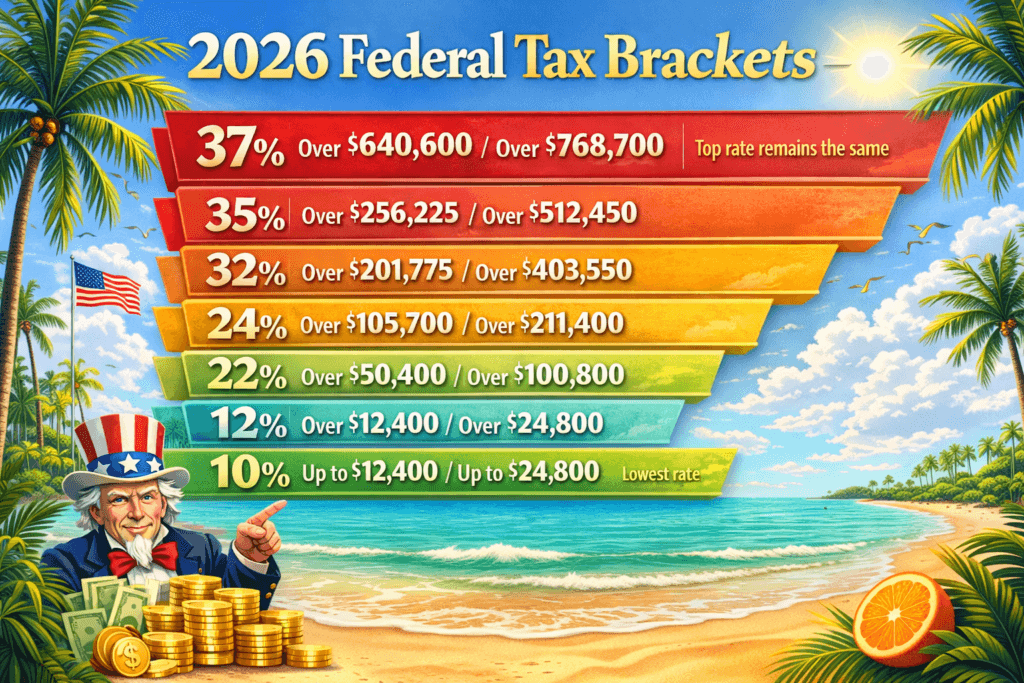
The One Big Beautiful Bill (OBBB), signed into law in 2025, extends many provisions of the Tax Cuts and Jobs Act and adjusts more than 60 tax items for inflation. The IRS lists the 2026 standard deduction amounts: $32,200 for married couples filing jointly, $16,100 for single taxpayers and married individuals filing separately, and $24,150 for heads of household. The bill also keeps seven marginal tax rates. The thresholds for each tax bracket for single filers and married couples filing jointly are as follows:
Because your taxable income includes 401(k) withdrawals, understanding where your income falls within these brackets matters when deciding how much to withdraw. Florida retirees with large account balances may inadvertently cross thresholds that increase their marginal rate from 12% to 22% or higher, particularly when RMDs begin. The standard deduction reduces taxable income, but any withdrawal in excess of it still faces marginal rates.
Impact of the Tax Cuts and Jobs Act (TCJA) sunset
The TCJA of 2017 lowered marginal tax rates and increased the standard deduction. Many of its provisions were scheduled to expire after 2025, potentially causing tax rates to revert to higher pre‑2017 levels. However, the OBBB extends the lower rates into 2026 and permanently eliminates personal exemptions. The 2026 tax brackets shown above reflect inflation adjustments rather than a reversion to pre‑TCJA brackets. Nonetheless, Congress could change the tax code again; retirees should stay informed about legislative updates.
Updated 2026 contribution limits and catch‑up rules
Saving for retirement doesn’t end when you retire—many retirees continue to contribute to their 401(k) or IRA while working part‑time. The IRS adjusts contribution limits each year for inflation. For 2026, the key limits for employer‑sponsored plans and IRAs are:
401(k), 403(b) and 457 plans
According to the IRS’s notice on cost‑of‑living adjustments, the elective deferral limit (amount you can contribute to a 401(k) or similar plan) increases from $23,500 to $24,500 in 2026. Workers aged 50 or older can make additional catch‑up contributions. The limit on catch‑up contributions for individuals 50+ rises from $7,500 to $8,000. A special “super catch‑up” for workers aged 60–63 (introduced by the SECURE 2.0 Act) remains at $11,250. These figures are echoed by the Florida Realtors association, which notes that the maximum 401(k) contribution will be $24,500, the catch‑up amount $8,000, and that workers aged 60–63 can still contribute up to $11,250.
Individual Retirement Accounts (IRAs)
For IRAs, the maximum annual contribution increases to $7,500 in 2026 (up from $7 000). The IRA catch‑up limit (for individuals 50+) is indexed for the first time and rises to $1,100, bringing the total possible contribution for someone age 50+ to $8,600. These limits apply to both traditional and Roth IRAs.
Roth catch‑up requirement for high earners
The SECURE 2.0 Act introduces a new wrinkle: high‑earning employees (i.e., those earning more than $150,000 in wages in the prior year) must make their catch‑up contributions on a Roth basis starting in 2026. The IRS notice states that the Roth catch‑up wage threshold used to determine whether catch‑up contributions must be designated as Roth increases from $145,000 to $150,000. As Elder Law Answers explains, this rule means that high earners aged 50+ will lose the immediate pretax deduction for catch‑up contributions; instead, those contributions must go into a Roth account, meaning taxes are paid now but qualified withdrawals are tax‑free later. If an employer’s plan doesn’t offer a Roth option, those high‑earner participants may be unable to make catch‑up contributions at all. Schwab notes that this provision applies specifically to catch‑up contributions and encourages savers to review whether their plan offers a Roth 401(k) or to consider a Roth IRA or backdoor Roth conversion.
Why these limits matter for retirees
Higher contribution limits and Roth requirements might not seem relevant if you’ve already retired. But many Florida retirees work part‑time or consult, allowing them to continue saving. Contributing to a 401(k) or IRA while still earning income can extend the tax‑deferral on part of your paycheck and help offset required withdrawals. If you are 50+ and still working in 2026, you could contribute up to $32,500 (regular + catch‑up) to your 401(k). At age 60–63, the limit rises to $35,750. These savings can provide a cushion that may be converted to Roth assets later.
However, high‑earning retirees should be aware that if their wages exceed $150,000 (indexed), their catch‑up contributions will have to be Roth contributions, which are not tax‑deductible now. On the plus side, Roth catch‑up contributions grow tax‑free and do not increase future RMDs since Roth 401(k) accounts will be exempt from pre‑death RMDs from 2024 onward.
The “hidden” 401(k) tax problem: stacking income and bracket creep
Now that we understand how 401(k) distributions and tax brackets work, let’s examine the problem many Florida retirees don’t anticipate: stacking income. Retirees often have multiple income sources—Social Security benefits, pension payments, interest and dividends, capital gains, part‑time wages, and withdrawals from tax‑deferred accounts. Each 401(k) withdrawal adds to your taxable income and can push you into a higher bracket. The cumulative effect is sometimes called bracket creep. Without careful planning, you could inadvertently move from the 12% bracket to the 22% or even 24% bracket, eroding the benefits of living in a tax‑friendly state.
Example: RMD bracket buster
Consider a married couple in Florida, both age 73, with the following income in 2026:
- Social Security benefits: $36,000 (half of which counts toward combined income for tax purposes).
- Pension income: $20,000.
- Interest and dividends: $5,000.
- RMDs from their 401(k) and IRA: $50,000.
Their combined income for Social Security tax purposes is their adjusted gross income ($20,000 + $5,000 + $50,000) plus half of their Social Security benefits ($18,000), totaling $93,000. Because their combined income exceeds $44,000, 85% of their Social Security benefits will be subject to federal tax. When they compute their taxable income, the pension, interest, dividends, RMDs and 85 % of Social Security benefits amount to roughly $89,600. After the standard deduction for married filing jointly ($32,200), their taxable income is about $57,400. That places part of their income into the 22% bracket (threshold begins at $50,400 for single filers or $100,800 for married filers). Had they been able to reduce RMDs or spread withdrawals over multiple years, they might have remained entirely within the 12% bracket.
Impact on Medicare premiums and other taxes
Higher taxable income not only increases your marginal tax rate; it can also raise your Medicare Part B and Part D premiums. The Income‑Related Monthly Adjustment Amount (IRMAA) imposes surcharges on Medicare premiums for high‑income retirees. These surcharges kick in at modified adjusted gross income (MAGI) thresholds ($103,000 for single filers or $206,000 for married couples in 2026, though actual numbers may differ). Large 401(k) withdrawals can cause your MAGI to exceed these thresholds, increasing Medicare premiums for the following year. Similarly, bracket creep could affect eligibility for certain credits (e.g., the savers’ credit) or the amount of tax on long‑term capital gains if you sell investment assets.
The Roth conversion paradox
One strategy to mitigate RMD impacts is to convert traditional 401(k) or IRA assets to a Roth account before RMD age.Performing Roth conversions during years when you’re in a lower tax bracket can reduce future RMDs and provide tax‑free income later. However, Roth conversions themselves create taxable income in the year of conversion. If done without planning, a conversion can push you into a higher bracket immediately. The challenge is to convert enough to lower future RMDs but not so much that you create bracket creep today.
Get a complementary Found Money Tax report: We’ll analyze your situation to uncover potential tax savings and educate you on strategies like Roth conversions, Social Security taxation, and net unrealized appreciation — so you make informed decisions.
SECURE 2.0 and other legislative changes affecting retirees in 2026
The SECURE 2.0 Act, signed into law in December 2022, introduced numerous retirement reforms. Several provisions take effect in 2026 and beyond:
- RMD age increases – RMD age increased to 73 in 2023 and will rise to 75 in 2033. This change gives retirees more time to perform Roth conversions or strategic withdrawals before mandatory distributions begin.
- Elimination of pre‑death RMDs for Roth 401(k) accounts – Starting in 2024, Roth accounts in 401(k) plans no longer require RMDs. If you plan to keep money in your Roth 401(k), you won’t be forced to withdraw, further underscoring the value of Roth contributions.
- Roth catch‑up requirement – As discussed above, individuals who earn more than $150,000 in wages in the previous year must make their catch‑up contributions to an employer plan on a Roth basis starting in 2026.
- Higher catch‑up limits for ages 60–63 – SECURE 2.0 created a “super catch‑up” allowing workers aged 60–63 to contribute an additional 50 % above the regular catch‑up limit. The limit is $11 250 for 2026, providing a powerful opportunity to increase retirement savings near retirement age.
- Starter 401(k) plans – Employers can offer starter 401(k) plans with simplified requirements and auto‑enrollment; contributions are limited to **$6,000 plus a $1 100 catch‑up for workers age 50+, according to the IRS notice. Although this is lower than standard 401(k) limits, it can be an entry‑level option for small employers.
- Emergency savings – SECURE 2.0 allows certain plans to offer emergency savings accounts linked to retirement plans. Contributions are taxed pre‑tax but withdrawals for emergencies are penalty‑free (subject to conditions). While not specific to 2026 tax, it highlights the evolution of retirement savings vehicles.
Strategies for Florida retirees to manage the 401(k) tax burden in 2026
Understand your income mix
Start by listing all expected sources of income: Social Security, pensions, annuities, wages, interest, dividends, capital gains and planned withdrawals from retirement accounts. Estimate your combined income and taxable income to determine which tax bracket you will fall into under the 2026 schedule. Remember that half of your Social Security benefits counts toward combined income. Tools like the IRS Tax Withholding Estimator or professional tax software can help you project your tax liability.
Time your withdrawals carefully
One of the most effective ways to reduce bracket creep is to spread out withdrawals. Instead of taking large distributions in a single year, consider smaller, annual withdrawals starting in your early 60s. Taking distributions before RMD age can reduce the account balance subject to RMDs later, potentially lowering the required amounts. This strategy may also reduce the portion of Social Security benefits subject to taxation. However, be aware of the 10 % penalty for withdrawals from a traditional 401(k) before age 59½ (with some exceptions). Once you reach age 59½, penalty‑free withdrawals are allowed.
Perform partial Roth conversions
Roth conversions can lower future RMDs and create tax‑free income. To minimize bracket creep, consider converting only enough each year to fill up a lower bracket. For example, if you are married and expect your taxable income to be $80,000 in 2026, you might convert only the amount that keeps you below the $100,800 threshold where the 22 % bracket begins. Roth conversions not only reduce the size of your traditional 401(k) but also provide a hedge against future tax increases. Because Florida does not tax retirement income, you won’t face state income tax on the conversion.
Wondering if Roth Conversions are right for you? Request a free Roth Conversion Analysis.
Delay Social Security benefits (if feasible)
Claiming Social Security at full retirement age or earlier can increase your combined income and cause a larger portion of your benefits to be taxed. If you have other sources of income, delaying Social Security (up to age 70) can increase your monthly benefit and may allow you to manage RMDs first. Meanwhile, you can live on tax‑deferred savings and potentially convert some of those savings to Roth before your RMD age. Weigh this decision carefully, as delaying Social Security is not beneficial for everyone.
Learn how to Optimize Social Security.
Use Qualified Charitable Distributions (QCDs)
Once you reach age 70½, you can direct up to $100,000 per year from your 401(k) or IRA to a qualified charity via a Qualified Charitable Distribution. A QCD counts toward your RMD but is not included in your taxable income, effectively reducing your tax liability. QCDs are particularly valuable for retirees who wish to make charitable donations and avoid bracket creep. They also avoid the limitations on itemized deductions since they never appear as income or deduction.
Coordinate with Medicare and premium surcharges
Monitor your modified adjusted gross income to avoid IRMAA surcharges. These surcharges are based on income from two years prior, so large withdrawals in 2024 or 2025 could increase premiums in 2026 and 2027. If possible, spread large distributions over multiple years to stay below the IRMAA thresholds. Keep in mind that IRMAA brackets are subject to inflation adjustments.
Consider relocating within Florida or adjusting housing
Florida’s property taxes vary by county. Take advantage of the Homestead Exemption, which reduces the taxable value of your primary residence by up to $50,000, and additional exemptions for seniors with low incomes. The Save Our Homes cap limits annual increases in assessed value to 3% or the inflation rate, whichever is lower. If property taxes or insurance costs become burdensome, consider downsizing, relocating to a county with lower millage rates, or exploring age‑restricted communities where taxes may be lower.
Florida Retirement Cost Breakdown
Planning for estate and inheritance considerations
Florida’s lack of state estate or inheritance tax reduces the tax burden on heirs. However, federal estate taxes still apply to large estates. The IRS inflation adjustments set the federal estate tax basic exclusion amount at $15 million for decedents who die during 2026. Most retirees will not reach this threshold, but high‑net‑worth individuals should plan for potential estate tax. Keep in mind that inherited traditional 401(k) and IRA accounts must generally be emptied within 10 years under the SECURE Act rules (except for certain eligible beneficiaries). Those withdrawals are taxed as ordinary income to the beneficiary, potentially creating a tax spike for children or other heirs. Converting some assets to Roth or using trusts may help manage the tax impact on heirs.
Putting it all together: a Florida retiree case study
Let’s illustrate the 401(k) tax problem with a hypothetical Florida couple, Mike and Linda, both age 72 in 2025 (so they turn 73 in 2026). They worked in Orlando and now live in Winter Garden. Mike has $900 000 in a traditional 401(k), and Linda has $350,000 in a traditional IRA. They have saved $200,000 in a taxable brokerage account and $100,000 in a Roth IRA. They receive $4,000 per month in combined Social Security benefits ($48,000 a year) and Mike receives a $12,000 yearly pension.
Year 1: Age 72 (2025)
Mike and Linda are not yet subject to RMDs. They decide to withdraw $50,000 from Mike’s 401(k) to remodel their kitchen. Their taxable income is roughly the $50,000 withdrawal plus the $12,000 pension and 85 % of Social Security benefits (since combined income exceeds $44,000), totaling about $103,000. After the 2025 standard deduction ($31,500 for married filing jointly), their taxable income is around $71,500, which straddles the 12 % and 22 % brackets. Because of the large withdrawal, part of their income is taxed at 22 %. In hindsight, they could have taken a smaller withdrawal and financed part of the remodel with cash or a home equity line, thus spreading the tax impact over multiple years.
Year 2: Age 73 (2026)
RMDs begin for Mike and Linda. Mike’s RMD is $900 000 ÷ 25.6 (approximate life expectancy factor) ≈ $35,156. Linda’s RMD is $350 000 ÷ 27.2 ≈ $12,867. Their total RMD is $48,023. They also withdraw $10,000 from their brokerage account to cover vacation expenses. Their combined income (including half of Social Security) exceeds $100,000, so 85 % of Social Security benefits are taxed. Their taxable income (after the standard deduction of $32,200) will exceed $100,800, pushing part of their RMD into the 22% bracket. They had planned to convert some of Mike’s 401(k) to a Roth, but doing so in 2026 would raise their tax rate further. Instead, they could have converted some funds in 2025 while still in a lower bracket.
Year 3: Age 74 (2027)
The couple decides to implement a multi‑year Roth conversion strategy. They convert $40,000 of their 401(k) assets to a Roth IRA. The conversion is taxable but they manage it to stay within the 22 % bracket. Although they pay taxes on the conversion now, their future RMDs decrease. Over the next 10 years, they continue converting modest amounts each year. By the time they reach 80, a significant portion of their retirement savings has been moved to Roth accounts, reducing their RMDs and taxes on Social Security benefits.
Lesson: Without planning, RMDs can cause unexpected tax spikes. Florida retirees should evaluate their income mix, withdraw strategically, and consider Roth conversions when in lower brackets. The 2026 tax code’s higher standard deduction helps slightly but does not offset large distributions. Failing to plan could result in paying higher federal income taxes even in a state with no income tax.
Proactive Planning Beats Surprises
Many Florida retirees focus on the benefits of living in a state with no income tax. However, the primary tax burden on a traditional 401(k) comes from the federal government, not the state. The 2026 tax code keeps seven tax brackets but increases the standard deduction to $16,100 for single filers and $32,200 for married couples. Traditional 401(k) withdrawals are taxed at your marginal rate, and RMDs starting at age 73 can force you into a higher bracket, increasing taxes on Social Security benefits and potentially raising Medicare premiums. The SECURE 2.0 Act adds new wrinkles—higher catch‑up contribution limits and a Roth requirement for high earners—while offering more time before RMDs begin. Meanwhile, Florida’s lack of state income tax, homestead exemptions and absence of estate tax provide significant advantages, but they do not eliminate federal taxes.
To navigate this complex landscape, Florida retirees should estimate their future income and tax brackets, spread withdrawals over multiple years, and consider partial Roth conversions. They should also utilize strategies like Qualified Charitable Distributions, coordinate withdrawal timing with Medicare premium brackets, and take advantage of Florida’s homestead exemption. Proactive planning—ideally with the help of a financial representative or tax professional—can help you enjoy the benefits of Florida living without being blindsided by federal taxes on your 401(k).
Disclosure:This article is provided for educational and informational purposes only. It is not intended to constitute financial, tax, legal, or investment advice, nor should it be construed as an offer to sell or a solicitation of any product, service, or investment strategy. Individual financial situations vary, and the information discussed may not be appropriate for every reader. Tax laws, contribution limits, income thresholds, and other figures referenced are subject to change and may vary based on individual circumstances. Readers should verify all numbers, rates, and rules for accuracy and currency before making any financial decisions. Before taking any action, readers are strongly encouraged to review their personal situation with a qualified financial professional, tax advisor, attorney, or CPA to determine what is appropriate for their specific needs and objectives. The sources used in this article are believed to be reliable at the time of publication; however, accuracy and completeness cannot be guaranteed.