
A lot of people picture retirement as a hard stop. One day you are working full time, and the next day you never work again.
That is one way to retire. It is not always the best way.
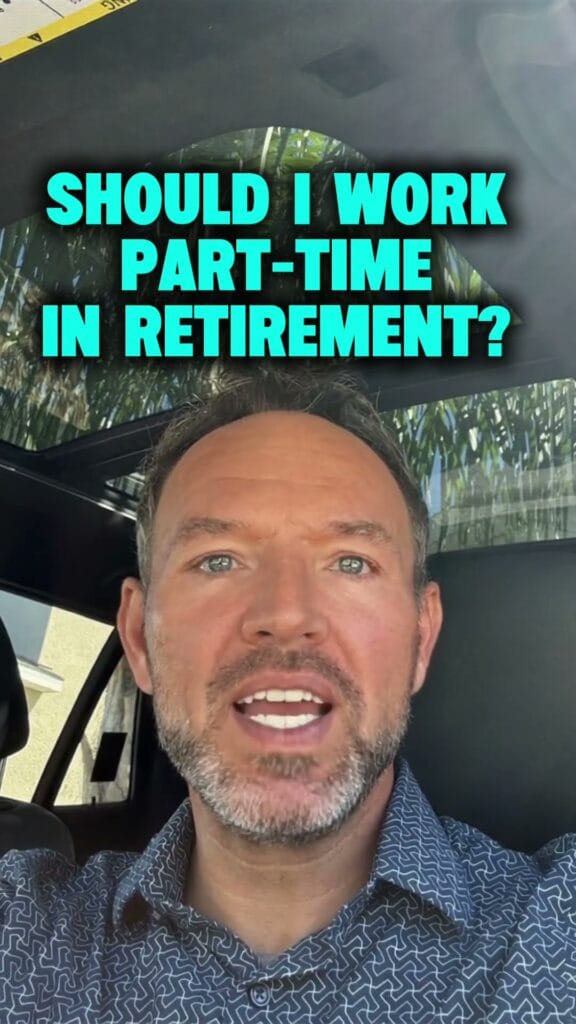
In Day 15 of my 50 Retirement Questions Answered series, I tackle a question I hear from pre-retirees in Orlando and across Central Florida all the time: “Should I work part-time in retirement?”
The short answer: even a modest paycheck can make a big difference. Earning just $20,000 a year from part-time work in retirement can reduce how much you pull from your 401(k), IRA and other savings by hundreds of thousands of dollars over a 30-year retirement. And the benefits go well beyond money.
Key Takeaways
- $20,000 a year of part-time income can reduce what you withdraw from savings by $600,000 over 30 years, before counting any investment growth.
- The first years of retirement matter most. Working part-time for just 5 years can leave your portfolio hundreds of thousands of dollars larger decades later.
- Part-time income can help you delay Social Security and lock in a larger lifetime benefit.
- Smaller withdrawals can mean lower taxable income in retirement.
- The non-financial benefits are real: social connection, mental sharpness, purpose and flexibility.
Video Transcript: Should I Work Part-Time in Retirement?
“Day 15 of the 50 retirement questions I get asked most often. Should I work part-time in retirement? Even 20,000 a year of part-time income can reduce how much you pull from savings by hundreds of thousands over a 30-year retirement. Plus, the social and mental benefits are real. Follow for day 16 tomorrow.”
Retirement Does Not Have to Mean Stopping Work Completely
The goal of retirement planning is not simply to quit working. The goal is to create the freedom to live retirement on your terms.
For some people, that means never clocking in again. For many others, it means trading a demanding career for work they actually enjoy, on a schedule they control. Consulting a few days a week, working a seasonal job, teaching, or turning a hobby into a small business can all fit into a well-built retirement plan.
The key is understanding what that income does for the rest of your plan. It does more than most people expect.
The Math: How $20,000 a Year of Part-Time Income Protects Your Savings
Every dollar you earn in retirement is a dollar you do not have to withdraw from your investments. And every dollar that stays invested keeps working for you.
Here is a simple illustration. Imagine you retire with a $1,000,000 portfolio and need $60,000 a year from it to cover your lifestyle. Now compare what happens if part-time work covers $20,000 of that need for different lengths of time:
| Scenario | Total withdrawn over 30 years | Portfolio after 30 years | Difference vs. no part-time work |
|---|---|---|---|
| No part-time work ($60,000/yr withdrawals) | $1,800,000 | About $715,000 | None |
| Part-time work for the first 5 years | $1,700,000 | About $1,228,000 | About $513,000 more |
| Part-time work for the first 10 years | $1,600,000 | About $1,612,000 | About $896,000 more |
| Part-time work for all 30 years | $1,200,000 | About $2,391,000 | About $1,676,000 more |
Look at the second row. Working part-time for only five years reduces total withdrawals by $100,000, yet the portfolio ends up roughly half a million dollars larger. That is the power of leaving money invested and letting it compound.
Why the Early Years of Retirement Matter Most
The first five to ten years of retirement are the most fragile. If the market drops early and you are forced to sell investments to pay the bills, you lock in losses and have fewer shares left to participate in the recovery. This is called sequence of returns risk, and it is one of the main reasons retirees run out of money.
Part-time income acts like a shock absorber. When markets fall, a paycheck means you can withdraw less, or nothing at all, and give your portfolio time to recover. I explain this risk in more detail in my video on why living off returns alone can ruin a retirement plan.
Part-Time Work and Social Security: Delay Your Benefits and Get a Bigger Check
One of the biggest advantages of working part-time is that it can let you delay claiming Social Security. For every year you wait past your full retirement age, up to age 70, your benefit grows by 8%. That larger check is guaranteed for life and adjusts for inflation.
If you do claim Social Security before full retirement age while still working, know the earnings test rules for 2026:
- If you are under full retirement age for all of 2026, Social Security withholds $1 in benefits for every $2 you earn above $24,480.
- In the year you reach full retirement age, the limit rises to $65,160, and $1 is withheld for every $3 above it (counting only earnings before the month you reach full retirement age).
- Once you reach full retirement age, there is no earnings limit at all.
Benefits withheld under the earnings test are not lost forever. Your benefit is recalculated at full retirement age to account for them. Still, the timing matters, and it is worth planning carefully. Learn more about Social Security optimization and what age to collect Social Security.
The Tax Advantages of Working Part-Time in Retirement
Withdrawals from a traditional 401(k) or IRA are taxed as ordinary income. When part-time earnings replace some of those withdrawals, you have more control over your taxable income each year. That can help you:
- Stay in a lower tax bracket and avoid pulling large taxable distributions.
- Create room for Roth conversions in years when your income is lower.
- Keep saving. Earned income lets you keep contributing to an IRA or Roth IRA. For 2026, the IRA limit is $7,500, plus a $1,100 catch-up contribution if you are 50 or older.
- Reduce future required minimum distributions by leaving more room to plan withdrawals strategically.
Florida residents have an added edge: there is no state income tax on wages or retirement income. If you are self-employed, remember that self-employment tax applies to your net earnings. Explore our tax-efficient retirement strategies or run your numbers with the retirement tax calculator.
Part-Time Work Can Help Bridge the Gap to Medicare
If you retire before 65, health insurance is often one of the largest expenses in your budget. Some part-time jobs offer health benefits, and even when they do not, extra income makes private coverage easier to afford until Medicare begins. Read my guide on retiring before 65 and bridging the health insurance gap.
The Benefits Are Not Just Financial
The money matters, but many of my clients say the biggest rewards of working part-time in retirement are personal:
- More social connection. Work keeps you around people, which helps prevent the isolation many retirees feel.
- Staying mentally active. Learning, solving problems and staying engaged keep your mind sharp.
- A sense of purpose. Having somewhere to be and someone counting on you gives structure to your week.
- More flexibility. Extra income gives you more options for travel, family and the unexpected.
Part-Time Job Ideas for Retirees in Orlando and Central Florida
Central Florida offers plenty of flexible work that fits a retirement lifestyle, including:
- Consulting or contract work in your former industry
- Tourism and hospitality roles at attractions, resorts and events
- Golf course, marina and recreation jobs
- Substitute teaching, tutoring or adult education
- Seasonal tax preparation or bookkeeping
- Healthcare administration and patient services
- Real estate, property management or turning a hobby into a small business
How to Build Part-Time Income Into Your Retirement Plan
- Decide what you want your retirement to look like. How many hours, what kind of work and for how many years?
- Estimate your income gap. Compare your expected expenses with guaranteed income like Social Security and pensions.
- Coordinate with Social Security. Decide whether part-time income lets you delay claiming, and plan around the earnings test.
- Plan your withdrawals and taxes together. Use lower-income years for Roth conversions and tax-smart distributions.
- Have a backup plan. Health or job changes happen, so your plan should still work if part-time income ends early.
A comprehensive retirement plan puts all of these pieces together so each decision supports the others.
Frequently Asked Questions About Working Part-Time in Retirement
Is it a good idea to work part-time in retirement?
For many people, yes. Part-time income reduces how much you withdraw from savings, helps protect your portfolio during market downturns, can let you delay Social Security for a larger benefit, and provides social and mental benefits. The right choice depends on your health, goals and overall plan.
How much can part-time work save me in retirement?
Earning $20,000 a year for 30 years reduces your total withdrawals by $600,000. Because that money stays invested and keeps growing, the difference in your ending portfolio can be much larger. In our hypothetical example, working part-time for just the first five years left the portfolio about $513,000 larger after 30 years.
Does working part-time reduce my Social Security benefits?
Only if you claim before full retirement age and earn above the limit. In 2026, Social Security withholds $1 for every $2 earned above $24,480 if you are under full retirement age all year, and $1 for every $3 above $65,160 in the year you reach full retirement age. Withheld benefits are credited back when your benefit is recalculated at full retirement age, and after full retirement age there is no limit.
Can I contribute to an IRA if I work part-time in retirement?
Yes. You need earned income to contribute to an IRA or Roth IRA. For 2026, you can contribute up to $7,500, plus a $1,100 catch-up contribution if you are age 50 or older, but not more than your earned income for the year.
What are good part-time jobs for retirees in Florida?
Popular options include consulting in your former field, hospitality and tourism roles, golf and recreation jobs, tutoring or substitute teaching, seasonal tax preparation, healthcare administration, real estate, and small businesses built around a hobby.
Want to See How Part-Time Income Fits Your Retirement?
Every retirement is different. Whether you plan to stop working completely or keep a foot in the door, the right plan coordinates your income, Social Security, taxes and healthcare so you can retire with confidence. Book a free Clarity Session with me, Roger Fishel, and let’s map out a retirement that works on your terms.
This is Day 15 of my 50 Retirement Questions Answered series. Watch more retirement planning videos and subscribe on YouTube so you do not miss Day 16.
This content is for educational purposes only and does not consider your personal situation. It is not tax, legal or investment advice. The example above is hypothetical and does not represent any specific investment. Consult a qualified professional before making decisions.
Watch Next
More Retirement Videos
- February 25, 2026 Medicare Explained: Why Your Orlando Retirement Strategy Needs a Healthcare Structure Watch video →
- February 17, 2026 The Orlando Guide to What Age to Collect Social Security. Watch video →
- February 13, 2026 The Invisible Gap in Your Retirement Plan (Why You Need a Financial Quarterback in Orlando) Watch video →
